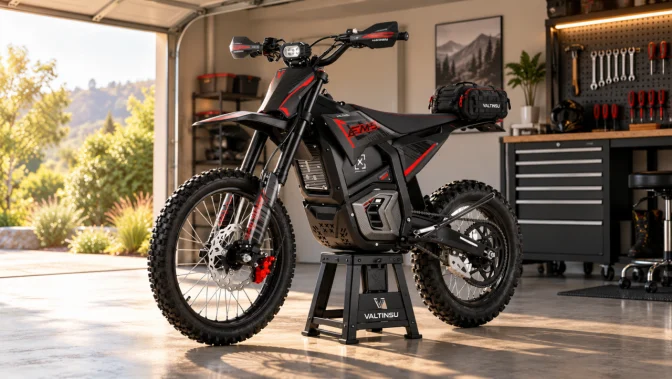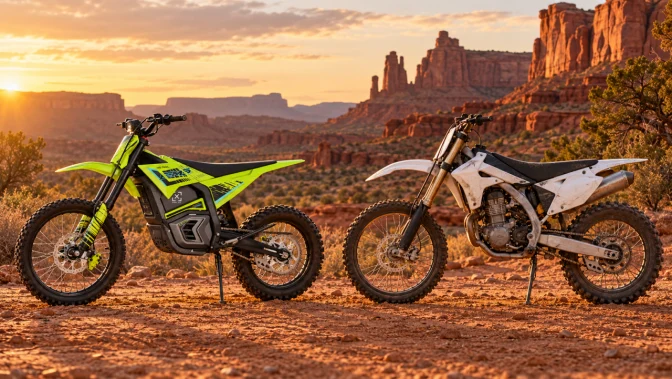
What CC Is an Electric Dirt Bike? Converting Watts to Gas Engine Size
Short version: it doesn't have one. There's no cylinder in an electric motor, and CC (cubic centimeters) only describes how much a gas engine's cylinders swallow on each stroke.
We still get the question every week. Usually it's someone who raced a 125 or a 250 in their twenties, has a kid or a bad knee now, and wants a rough idea of what an electric bike would feel like. Fair enough. Displacement was the number everybody used at the track, and watts don't mean much until you've ridden a few bikes. So below we line watts up against the old gas classes for any adult electric off-road motorcycle, then point out where that comparison falls apart on actual dirt.
Keep one thing in mind while reading the charts: a CC equivalent is a rough riding class. It isn't a conversion.
|
Quick answer Going by peak power only, a 50 is roughly 0.5 to 1.5 kW. The small pit bike crowd, the 110s, sit at 3 to 6 kW. Call a 125 anywhere from 6 to 11, a 250 something like 12 to 25 kW, and real 450 race bikes don't appear until about 40 kW. Gearing and rated power will move any given bike up or down a class. |
Why an Electric Dirt Bike Has No CC Rating

CC is short for cubic centimeters, and on a gas bike it's the volume the pistons sweep as they travel up and down (that's what people mean by engine displacement).
There's nothing like that in a motor. You've got copper windings, magnets and a spinning rotor. No piston, no combustion, so nothing to put a CC figure on.
Watts measure something else entirely: how fast work gets done. Size and power aren't the same quantity, which is why nobody can hand you an exact formula.
It's messy on the gas side too. A 125cc motocross two stroke and a kid's 125cc trail four stroke share a displacement and almost nothing else; the race bike makes several times the power.
Electric Dirt Bike CC Equivalent Chart

Treat it like a map. Shops and forums throw these bands around constantly, and they overlap, since no actual motorcycle lands dead in the middle of one.
|
Gas class |
Electric peak power |
Horsepower |
How it rides |
|
50cc |
0.5 to 1.5 kW |
0.7 to 2 hp |
Small riders, flat ground, short sessions |
|
110cc |
3 to 6 kW |
4 to 8 hp |
Pit bike pace, fire roads, moderate climbs |
|
125cc |
6 to 11 kW |
8 to 15 hp |
Lightweight adult trail performance |
|
250cc |
12 to 25 kW |
16 to 34 hp |
Serious trail and race level output |
|
450cc |
40 kW and up |
54 hp and up |
Full size competition machines |
For reference, the Sur-Ron Light Bee X is about a 6 kW bike, and it's the one people most often call 125 class. Owners usually say it feels light like a 125 but pulls harder at low speed, which is the gap this whole article is about.
How to Convert Watts to Horsepower
This part actually is exact. NIST puts one mechanical horsepower at roughly 745.7 watts, so you divide the watt figure by 745.7 (or multiply kilowatts by 1.34 if that's easier in your head).
|
Motor rating |
Horsepower |
Rough gas class |
|
2,000W |
2.7 hp |
Below 110cc |
|
3,000W |
4.0 hp |
Low 110cc |
|
5,000W |
6.7 hp |
110cc |
|
8,000W |
10.7 hp |
125cc |
|
10,000W |
13.4 hp |
Upper 125cc |
|
12,000W |
16.1 hp |
Entry 250cc |
What the table can't tell you is how the power arrives. Put 10.7 hp in an electric motor and 10.7 hp in a gas engine and you get two very different rides. Blame the torque curve.
What Watts Leave Out
Once the rear tire is on dirt, three things decide what a watt rating is worth.
Peak power and rated power
Peak is a burst, usually a few seconds before the controller backs off to protect the motor and battery. Rated (or continuous) power is what the bike can keep doing halfway up a long hill.
We'd look at both every time. A bike with a huge peak and a weak rated number pulls hard out of a berm and then goes soft ten minutes into a Colorado fire road climb.
Torque and reduction gearing

A gas engine has to be revving before it does much. An electric motor doesn't care; it pulls hard the moment you crack the throttle from a stop.
Reduction gears then multiply that pull on its way to the chain. Picture a rock ledge outside Moab taken at maybe 10 mph. A geared bike that, judged by horsepower alone, has no business making it will often walk right up. The number we'd hold up against your old bike is wheel torque.
Voltage, controller current and heat
The controller is the gatekeeper here, and if it's undersized the motor never sees its full rating.
Voltage plays in as well. Watts are just volts times amps. So a 72V bike makes the same power as a 48V bike on roughly a third less current, and less current is less heat in the motor and wiring. Battery health matters too (here are some habits that shorten electric dirt bike range), because a tired pack sags late in the day.
Heat is the quiet one. On a 110°F afternoon in Arizona, thermal protection can trim output with no warning light at all, and you just notice the bike seems slower than it was that morning.
|
Spec sheet red flag Be wary of any listing with a giant peak number and nothing else: no rated power, no controller amps, no torque. Ask for them. If nobody can answer, that tells you plenty. |
What 3,000W, 5,000W and 8,000W Bikes Compare To
Right now, almost everything adult sized in this market is 3 to 8 kW at peak.
|
Peak power |
Rough gas class |
Typical top speed |
Best fit |
|
3,000W |
50cc to 110cc |
30 to 40 mph |
Lighter riders, compact trails |
|
5,000W |
110cc |
40 to 50 mph |
Adult weekend trail riding |
|
8,000W |
125cc trail feel |
50 to 60 mph |
Faster trails, heavier riders, long climbs |
At 3,000W the gearing matters more than the motor. Short gearing climbs well and runs out of top end early. With tall gearing, an 80 kg rider bogs in sand.
By 5,000W the instant torque starts to show. In a slow uphill corner it can out pull a gas bike that has more horsepower on paper.
8,000W puts you in 125 territory for acceleration and trail pace, though a race tuned 125 two stroke still makes more at high rpm and refills in a couple of minutes. Over a two hour trail loop you'd rarely notice.
How to Compare an Electric Dirt Bike With Your Old Gas Bike

Forget the formula. Start with the bike you already know.
1. Write down what you liked about it: the hit coming onto the pipe, a front end you could flick around, how it chugged up hills in third.
2. Compare acceleration between 10 and 40 mph. That's where most trail miles happen anyway.
3. Look at rated power. Your old bike climbed for twenty minutes without fading, and the new one should too.
4. Weigh yourself in full gear with a loaded pack. Spec sheets assume a lighter rider than most of us.
5. Then check brakes, suspension travel and wheel size. Power you can't control is wasted.
|
From our team Riders coming off gas usually ask us for "a 125 equivalent." Talk a bit longer and it turns out they mean strong pull from 10 to 30 mph. Once the conversation moves from peak watts to wheel torque, the shortlist tends to change. |
Where the Valtinsu Lineup Sits on the Power Ladder
Valtinsu's four models make a decent example, since each step up adds voltage, power or torque.
|
Model |
Peak / rated power |
Wheel torque |
Top speed |
Rough gas class |
Age |
|
EM-5 |
3,840W / 1,200W |
148 lb-ft |
40 mph |
110cc pit bike |
13+ |
|
EM23 |
4,000W / 2,500W |
184 lb-ft |
43.5 mph |
110cc, cruiser |
16+ |
|
EM-5 Pro |
5,600W / 2,500W |
177 lb-ft |
52 mph |
Upper 110cc |
18+ |
|
EM-5 Ultra |
8,000W / 3,000W |
203 lb-ft |
56 mph |
125cc trail feel |
See page |
The EM-5 is the small one, a 48V geared mid drive bike that tops out at 40 mph. On paper that's pit bike class, but 148 lb-ft of wheel torque gets it up a 40 degree grade. It's rated 13+ and suits younger or lighter riders.
The EM23 cruiser is a different shape: 19 and 17 inch wheels, 2,500W rated, IPX4. Rated 16+, it's happier on light trails than in creek crossings.
For a returning adult rider, the EM-5 Pro with its 60V, 5,600W geared motor is usually where we'd start. It does 52 mph, up to 59 miles and a 45 degree climb, and it's rated 18+.
The 72V EM-5 Ultra

is the one that gets into 125 class acceleration, with 8,000W peak, a 72V 25Ah Samsung pack and a reverse gear (handy when you've nosed into a rut). It's aimed at experienced adult riders; check the product page for the current age rating.
To be fair to the competition, Sur-Ron and Talaria still have the deeper aftermarket and the race history. Valtinsu's pitch is more wheel torque for the money. All four models are on the electric dirt bike collection page if you want to compare them side by side.
Conclusion
So, no CC, and no formula that will invent one. You can still place a bike, though: convert the watts to horsepower, find the rough gas class, and then look at rated power, wheel torque and gearing to see whether it rides above or below that class.
If you're coming off a 125 trail bike, an 8 kW geared machine is the closest match we've found. Off a 110 pit bike, 4 to 6 kW is normally plenty. Either way, compare the adult electric dirt bike lineup against the terrain you actually ride.
And before heading onto public land, it's worth reading the BLM off highway vehicle guidance and CPSC's OHV safety guidance.
FAQs
How fast does a 3000W electric dirt bike go?
Around 30 to 40 mph for most of them. Gearing is the big variable. A bike set up to climb tops out sooner, while one geared for fire roads runs faster but feels softer at walking pace. Rider weight, wheel size and controller tuning nudge it further, so go by the speed the maker publishes.
What is the electric equivalent of a 50cc dirt bike?
Somewhere in the 500 to 1,500W range, going by peak power. The electric bike will feel quicker off the line than a mild 50 because the torque is there immediately. For a kid, honestly, seat height and brakes matter more than watts, and so does the manufacturer's age rating.
How fast does a 5000W electric dirt bike go?
Most of them run 40 to 50 mph. 5 kW works out to about 6.7 hp, but with reduction gearing it can climb like a bigger bike at low speed. We'd still pick one on rated power, torque and suspension before top speed.
How fast does a 4000W electric dirt bike go?
35 to 45 mph is typical, from about 5.4 hp. Valtinsu's EM23 has 4,000W peak and a 43.5 mph top mode, for example. Another 4,000W bike with taller gearing could look quicker on paper and still be slower up a hill.
How fast is 72V 8000W in mph?
Usually 50 to 65 mph, though the label alone won't tell you. Top speed comes from motor rpm limits, the sprockets and the wheel size. Valtinsu sets its 72V, 8,000W EM-5 Ultra to 56 mph in the top mode, for instance. Trust the maker's speed rating over the motor sticker.
How much HP is 72V 5000W?
About 6.7 hp. That's 5,000 divided by 745.7, and the 72V doesn't enter into it because watts are already a power figure. Where voltage shows up is current and heat, which decide how long a bike can keep making that 6.7 hp.
Is there an electric dirt bike that can go 100 mph?
Not in the lightweight trail class. A few full size electric motorcycles go past 100 mph, but they carry much bigger batteries, cooling, tires and brakes. Trail bikes trade all that for low weight and torque. On singletrack, 40 to 60 mph is already more than most of us use.
How fast is a 10,000 watt electric dirt bike?
Often 55 to 65 mph. Ten kilowatts is roughly 13.4 hp, upper 125 territory. The real figure moves with gearing, rider weight and heat. Check sustained power and brakes too, not just the speed claim.


Looking for something else?
Electric Dirt Bike Replacement Parts Availability: What Buyers Should Verify Before Ordering
LEARN MORE
How to Check an Electric Dirt Bike for Safety Recalls by Model and Serial Number
LEARN MORE
How to Choose an Electric Dirt Bike Repair Shop: Questions to Ask Before Service
LEARN MORE
How to Lift a Fallen Electric Dirt Bike Without Hurting Yourself or the Bike
LEARN MORELooking for something else?
Electric Dirt Bike Fall Riding on Wet Leaves: Grip, Hidden Obstacles and Braking
LEARN MORE
Electric Dirt Bike Trailside Power Loss: Recovery Plan When the Battery Is Dead
LEARN MORE