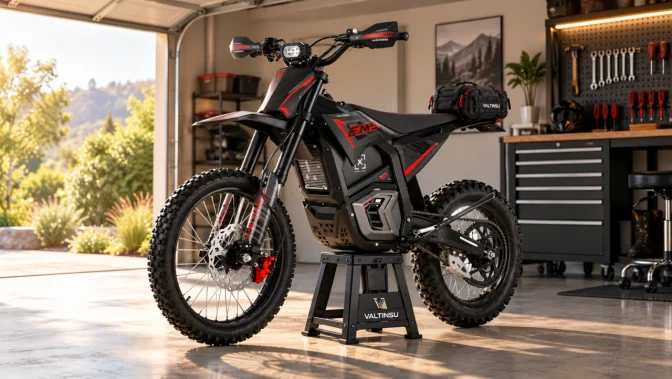
How Electric Dirt Bike Tire Size Changes Torque, Speed and Handling
Electric dirt bike tire size changes the effective rolling radius between the axle and the ground. A larger outside diameter generally reduces wheel force for the same axle torque while covering more distance per wheel revolution, and a smaller diameter does the opposite. Weight, tire width, geometry, clearance and controller calibration all affect the real result.
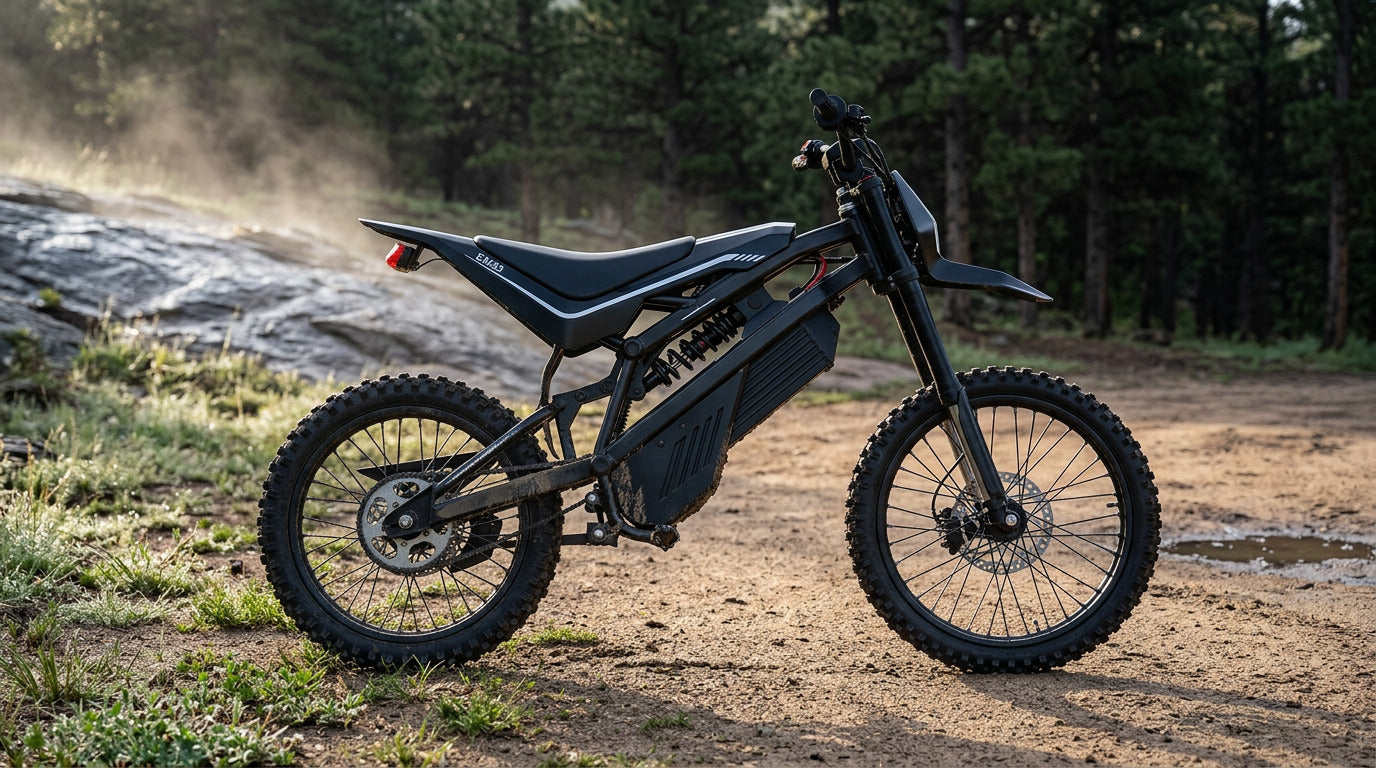
Two adult electric dirt bikes sit side by side on firm dirt. One rides a compact 17/14-inch platform, the other a larger 19/17-inch setup, and the taller bike looks like it should be faster and better over obstacles.
On an adult electric off-road motorcycle, none of that follows automatically. What actually changes depends on rim diameter, tire width, aspect ratio, mounted outside diameter, tire and wheel mass, sprocket ratio, motor reduction, clearance, suspension geometry and what the controller and speed sensor assume. The rule worth carrying through the rest of this article is simple: compare complete rolling diameter, never rim diameter alone.
Rim Diameter Is Not Tire Outside Diameter
In a marking such as 90/90-14, Michelin’s guidance is explicit about what each number means. The first is the nominal section width in millimeters, the second is the aspect ratio expressing sidewall height as a percentage of that width, and the last is the bead-seat diameter of the wheel in inches.
Outside diameter is a different measurement entirely. It adds the rim diameter and both sidewalls, so it changes whenever width or aspect ratio changes even if the rim number stays put. Work the example through: 90 mm of width at a 90 percent aspect ratio gives roughly 81 mm of sidewall, a 14-inch rim is 355.6 mm, and the total comes to about 518 mm, or roughly 20.4 inches.
Treat that as a geometric estimate, not a fitment specification. Mounted diameter shifts with manufacturer, rim width, tread depth, inflation, load and carcass construction, which is why Michelin’s technical reference distinguishes radius without load from radius under static load. Two tires fitting the same 14-inch rim can differ in outside diameter, circumference, ground clearance and effective gearing. Never read "17-inch tire" as 17 inches of outside diameter unless a specification says so.
Diameter Changes Effective Gearing

Chain sprockets set the mechanical final-drive ratio, but tire radius decides how axle rotation becomes movement at the ground. Change the tire and you change the effective overall gearing even though the motor, reduction gear and both sprockets are untouched.
Ground force depends on axle torque divided by the effective rolling radius. Increase the radius at the same axle torque and the force available at the contact patch falls, which is why an 80 kg adult starting a firm Colorado climb may feel slightly less immediate drive after a rear diameter increase with no other gearing change. Decrease the radius and ground force rises. Three quantities stay distinct throughout: motor torque, axle torque and ground force are not the same thing, and a smaller tire never adds motor torque.
Circumference works the other way. At identical wheel RPM, a larger circumference covers more distance per revolution and raises theoretical vehicle speed, while a smaller one lowers it. The word theoretical is doing real work there, because actual top speed may stay limited by motor RPM, controller programming, aerodynamic drag, available power, battery voltage, tire growth, terrain or an electronic limit.
A worked comparison makes the scale clear. Take a stock rolling diameter of 20.0 inches against an alternative at 21.0 inches, a 5 percent increase. If wheel RPM were held exactly unchanged, distance per revolution and theoretical speed would each rise by about 5 percent, and ground force from the same axle torque would fall by roughly the inverse. That is mathematics rather than a prediction: it accounts for none of the added tire mass, motor load, controller limits, wheelspin, deformation, tire growth or real rolling radius, and it is not a recommendation to make the change.
A sprocket change can push effective gearing in a similar direction, but the two modifications are not equivalent. A tire change also alters circumference, ride height, geometry, rotational inertia, unsprung mass and clearance, and neither modification should be used to "correct" the other outside manufacturer-approved procedures.
Weight and Rotational Inertia Change the Feel

Two tires of equal diameter can behave differently because of what they weigh and where that weight sits. Static mass is simply added to the motorcycle, while rotating mass has to be accelerated angularly with the wheel as well as carried along. Rotational inertia also depends on distribution rather than total alone, so mass concentrated farther from the hub has a stronger effect than the same mass near the axle.
The wheel and tire package is unsprung mass too, along with the tube or insert, rim, spokes, hub and part of the braking hardware. Increasing it can make the suspension’s job harder when the wheel needs to move rapidly over repeated irregularities, and a heavier rear tire crossing Colorado washboard asks more of the rear shock than a lighter approved setup does.
Heavier is not automatically worse, since a heavier carcass may bring strength, puncture resistance and durability a rider values more than response. Riders may notice differences in acceleration, deceleration, suspension reaction, steering response and energy used during repeated speed changes, and none of it reduces to a fixed conversion between wheel weight and chassis weight.
Diameter Also Changes Geometry, Rollover and Clearance
A larger-radius wheel meets a given obstacle at a shallower geometric engagement angle, which can make a square edge feel less abrupt. A smaller wheel meets the same edge at a steeper relationship and may feel more responsive on smooth ground while being less forgiving over larger trail edges. Diameter alone does not decide obstacle capability, though, because suspension, tire compliance, speed, obstacle shape, rider input and wheelbase all contribute.
Front and rear diameter changes affect the chassis differently. A taller or shorter front tire can alter front ride height, the steering axis relationship to the ground, trail, weight distribution, corner-entry response and straight-line feel. Changing only the rear rolling radius can alter rear ride height, chassis pitch, seat height, ground clearance, swingarm angle and effective gearing. Raising both together is not the same as raising one, so no universal statement such as "taller always slows the steering" survives contact with real setups, where rear ride height, suspension sag, fork position and tire profile all interact.
Ground clearance follows the same pattern. If effective rolling radius increases, axle height rises by roughly the radius change when everything else is equal, which may lift axle height, some chassis clearance and seat height. Not every point under the bike moves by the same useful amount, and tire compression, suspension sag, chassis geometry and skid-plate position all matter, so a larger tire is not a guaranteed clearance upgrade.
None of this is an invitation to compensate through fork height, shock length, linkage or suspension adjustment. Those changes belong to exact manufacturer instructions.
Width, Diameter and Weight Are Three Different Variables
|
Variable |
Main mechanical effect |
Possible handling effect |
Possible range effect |
Fitment risk |
|
Diameter |
Rolling radius, circumference, effective gearing, ride height |
Rollover behavior, steering geometry, stability |
Changes distance per revolution and motor operating point |
Fender, fork and swingarm height clearance |
|
Width |
Tire profile, carcass support, contact-patch shape |
Steering feel, surface interaction, flotation |
Rolling resistance and terrain interaction |
Lateral clearance at chain, sprocket and swingarm |
|
Weight |
Rotational inertia and unsprung mass |
Acceleration, braking and suspension response |
Energy needed for repeated speed changes |
Wheel and spoke load capacity |
One correction matters here. A wider tire does not automatically create a larger contact-patch area, because area depends on load, inflation pressure, casing, tread and how the terrain deforms. Width strongly changes the shape of the contact patch, not its area by itself. A tire can also become heavier without becoming much taller, or taller without becoming much wider, so "bigger tire" is never one engineering variable.
Range and Speed Readings Both Shift

A larger circumference means fewer wheel revolutions per mile, which sounds like an efficiency gain until the rest of the system is counted. Motor RPM and internal reduction still matter, and a larger or heavier tire may add rotational inertia, rolling resistance, drag, deformation and acceleration energy. On hardpack an efficient tire of suitable diameter may roll predictably, while in Arizona sand a larger tire improves rollover but sinks can consume more battery. Range depends on total energy required at the battery, not circumference alone.
Speed indication moves as well. If a motorcycle estimates road speed from wheel rotation against a calibrated circumference, changing that circumference can change displayed speed and distance unless the system compensates, because the wheel makes fewer revolutions per actual mile. Whether a given model works that way is a documentation question, so check the exact-model documentation before assuming any recalibration is needed or possible.
Valtinsu Platforms Show Why Wheel Size Is Only One Variable

Published wheel formats. Published format, not complete tire outside diameter.
Front and rear wheels do different jobs, which is why staggered formats exist at all. Front priorities lean toward steering, obstacle rollover and directional control, while rear priorities lean toward drive traction, torque transfer, packaging and swingarm clearance. Our electric dirt bike tire guide covers tread and terrain choices alongside these dimensions.
|
Specification |
EM-5 Pro |
EM23 |
What the difference can influence |
|
Wheels |
17 in front, 14 in rear |
19 in front, 17 in rear |
Rollover geometry, ride height, effective gearing |
|
Seat height |
31.5 in |
31.9 in |
Rider fit and reach to the ground |
|
Wheelbase |
41.7 in |
41.7 in |
Stability, and identical here despite different wheels |
|
Net weight |
143 lb |
131 lb |
Handling effort and unsprung-to-sprung relationship |
|
Motor |
60V 5,600W geared |
60V 4,000W geared |
Available power, which is not a wheel-size effect |
|
Listed torque |
177 lb-ft |
184 lb-ft |
Axle torque available before rolling radius is applied |
The larger EM23 wheels cannot be isolated as the reason for any difference in speed, acceleration, torque, handling or range, because the two platforms also differ in motor, controller, mass, suspension and gearing. Neither geometry is universally better. The EM-5 Pro, also offered in Volt Green, and the EM23 are complete design choices rather than evidence that one should be converted into the other.
The clearest proof sits inside the EM-5 family. The EM-5 Pro and the EM-5 Ultra both list 17-inch front and 14-inch rear wheels, yet the Ultra runs 72V against 60V, 8,000W against 5,600W, 203 lb-ft against 177 lb-ft, 56 mph against 52 mph, and a listed range up to 75 miles. An identical wheel format produces neither identical speed nor identical torque nor identical range, and changing wheel size alone cannot recreate another model’s performance.
Competitor Wheel Architectures Differ Too
|
Model |
Wheels |
Published tires |
Drive architecture |
|
Valtinsu EM-5 Pro |
17 in front, 14 in rear |
Not published as mounted sizes |
Geared motor with chain final drive |
|
Valtinsu EM23 |
19 in front, 17 in rear |
Not published as mounted sizes |
Geared motor with chain final drive |
|
Sur-Ron Light Bee X |
19 by 1.4 in front and rear |
70/100-19 front and rear |
Belt primary with 420 chain secondary |
|
Talaria Sting R MX4 |
19 in front and rear |
70/100-19 front, 80/100-19 rear |
Gearbox primary with chain secondary |
Handling cannot be ranked from wheel diameter across these four, because the drive architectures differ as fundamentally as the wheels do. Sur-Ron and Talaria both bring a larger aftermarket wheel and tire ecosystem, broader owner fitment data and stronger resale recognition, and Sur-Ron adds race pedigree. That depth is useful, and it is also why fitment knowledge does not transfer: a tire proven on a Talaria or a modified Sur-Ron is not thereby Valtinsu-compatible.
Compatibility Is More Than Rim Diameter

Matching the rim diameter is the beginning of a fitment check, not the end of one. Bead-seat diameter, approved rim width, tire section width and actual mounted outside diameter all have to be confirmed, then checked against fork, swingarm, chain, sprocket, fender and mud clearance. Brake rotor compatibility, caliper clearance, hub and axle dimensions, spacer arrangement, spoke and rim load capacity, tire load rating, any applicable speed rating, tube or tubeless compatibility and rotation direction complete the list.
Michelin is direct that replacement selection must weigh size, construction, load index and speed rating against the motorcycle’s specification, and that the owner’s manual is the reference. NHTSA’s replacement principle points the same way: buy the size the vehicle came with, or another size the manufacturer recommends. Federal rulemaking on motorcycle tires goes further still, noting that the pressures furnished by the motorcycle manufacturer through the manual and placard are the authoritative ones and that the sidewall marking is not the source for recommended operating pressure.
The practical failure mode is a tire that seats correctly and still does not fit. A 90/100-14 may sit properly on the right 14-inch rim while being too tall or too wide for the swingarm, chain or fender. An OEM-specified size brings known frame clearance, known geometry, known speed calibration, a known suspension relationship and manufacturer-supported fit, whereas a larger aftermarket size changes effective gearing, clearance, geometry, rotational inertia, unsprung mass, steering, range and speed indication at once. None of that makes it an upgrade until compatibility has been confirmed.
Some assumptions should be discarded outright: fitting a wider tire because the rim number matches, mixing unapproved front and rear diameters, ignoring wheel load capacity, trimming knobs for chain clearance, dishing or offsetting a wheel, modifying swingarm clearance, removing guards, improvising axle spacers, moving a rotor, altering sprockets to compensate, changing suspension height to restore geometry, or fitting bicycle tires to motorcycle-duty wheels without verified ratings. If correct fit requires cutting, grinding, forced spacing or interference, it is not a normal tire replacement. Record your exact model, current sidewall code, rim marking and measured clearances, then confirm against the manual and support before ordering from the Valtinsu accessories collection or anywhere else.
Conclusion
Rim size is not outside diameter, and width and aspect ratio together decide sidewall height. Diameter changes effective gearing, so a larger rolling radius reduces ground force at the same axle torque while a larger circumference raises theoretical speed per wheel revolution. Tire mass changes inertia, wheel size influences geometry and obstacle rollover, and width changes profile and clearance rather than guaranteeing contact area.
Real range depends on the complete system, and real fitment depends on far more than a matching rim number. Compare wheel and tire fit properly before buying parts from the accessories collection or considering any non-stock size, and browse the riding guides for the terrain side of the decision.
FAQS
What size tires do electric dirt bikes use?
Adult electric dirt bikes use several formats. The Valtinsu EM-5 Pro and EM-5 Ultra run 17-inch front and 14-inch rear wheels, the EM23 runs 19/17, and the Sur-Ron Light Bee X and Talaria Sting R MX4 both run 19-inch wheels front and rear. Wheel size and tire sidewall size are separate specifications.
What does 80/90-14 mean on a dirt bike tire?
It describes a tire with a nominal section width of 80 mm, a sidewall height equal to 90 percent of that width, mounted on a 14-inch bead-seat diameter rim. Actual mounted dimensions vary with manufacturer, rim width, tread depth, inflation and load.
What does 90/100-14 mean on a dirt bike tire?
The structure is identical: 90 mm nominal width, sidewall height at 100 percent of that width, 14-inch rim. Compared with 80/90-14, both the width and the aspect ratio are larger, so outside diameter grows even though the rim number has not changed at all.
How do you check electric dirt bike tire size?
Read the code moulded into the tire sidewall, check the marking on the rim, then confirm both against the owner’s manual and the manufacturer’s fitment information. Visual estimation is not reliable, because two tires on the same rim size can differ noticeably in mounted height and width.
Does a bigger tire give an electric dirt bike more top speed?
A larger circumference covers more distance per wheel revolution, which raises theoretical speed at the same wheel RPM. Actual top speed still depends on motor RPM, load, available power, controller limits, mass, aerodynamic drag and terrain, so the theoretical gain may never appear.
Does a bigger tire reduce torque?
It does not reduce motor torque. A larger rolling radius reduces the ground force produced from the same axle torque, which behaves like taller effective gearing. Motor torque, axle torque and ground force are three separate quantities, and only the last one changes here.
Does tire size affect electric dirt bike range?
Yes, through several routes at once: rolling resistance, tire mass, rotational inertia, circumference, terrain interaction, wheelspin and where the motor ends up operating. No universal percentage applies, because the direction and size of the effect depend on the tire and the terrain.
Why do dirt bikes use a larger front wheel than rear wheel?
Because the two wheels have different jobs. The front prioritises steering, obstacle rollover and directional control, while the rear prioritises drive traction, torque transfer, packaging and swingarm clearance. Staggered formats suit those priorities, and they are not universally superior to matched formats.
Can I put bigger tires on my electric dirt bike?
Only with manufacturer-approved or professionally verified fitment. Confirm rim width, mounted outside diameter, section width, and clearance at the fork, swingarm, chain, sprocket, fender and brake, plus load rating and any applicable speed rating, before ordering anything.
Is a bigger electric dirt bike tire always better?
No. Better obstacle rollover or added ground clearance is weighed against taller effective gearing, added mass, slower response, tighter clearances, altered geometry, changed range and real compatibility risk. Bigger is a trade, and which side of it wins depends on the bike and the terrain.
Sources
- Michelin, How to Read a Motorcycle Tire and Tire Markings
- Michelin, How to Choose the Right Motorcycle Tire
- Michelin, Reading Tire Markings (definitions of radius without load, radius under static load, and outer diameter)
- National Highway Traffic Safety Administration, Tire Safety Ratings and Awareness
- U.S. Federal Register, Motorcycle Tire Inflation Pressure Marking (NHTSA, 2016)


Looking for something else?
Electric Dirt Bike Replacement Parts Availability: What Buyers Should Verify Before Ordering
LEARN MORE
How to Check an Electric Dirt Bike for Safety Recalls by Model and Serial Number
LEARN MORE
How to Choose an Electric Dirt Bike Repair Shop: Questions to Ask Before Service
LEARN MORE
How to Lift a Fallen Electric Dirt Bike Without Hurting Yourself or the Bike
LEARN MORELooking for something else?
Electric Dirt Bike Fall Riding on Wet Leaves: Grip, Hidden Obstacles and Braking
LEARN MORE
Electric Dirt Bike Trailside Power Loss: Recovery Plan When the Battery Is Dead
LEARN MORE