Electric Dirt Bike Motor Efficiency: Where Battery Energy Is Lost
Battery energy does not reach the rear wheel one for one. Some is lost as heat and friction at every stage: battery internal resistance, wiring and connectors, the controller, motor windings and magnetic materials, reduction gearing, bearings, the chain and sprockets, and finally the tires and terrain. How much is lost changes with motor speed, torque demand, temperature, surface and riding style.
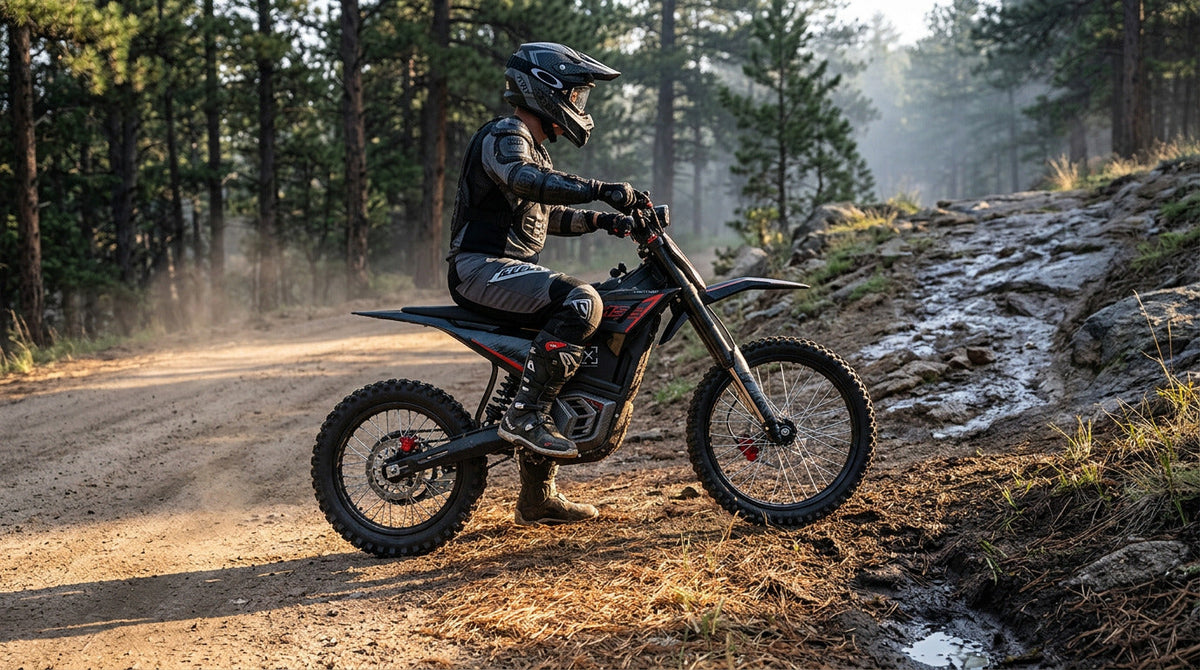
An electric dirt bike leaves a firm fire road and begins a slow Colorado climb. The battery may be delivering substantial electrical power at that moment, but not every watt becomes useful work at the rear wheel.
This article follows one question through an adult electric off-road motorcycle: where does battery energy go between the pack and the ground? Answering it means separating power from energy, battery watts from wheel watts, peak efficiency from average trail efficiency, electrical losses from mechanical losses, and drivetrain efficiency from total vehicle consumption. No electric motor runs at one fixed efficiency, so you will not find a single percentage below.
Start With the Battery-to-Wheel Energy Flow

Conceptual battery-to-wheel energy flow. Loss magnitudes are not drawn to scale.
Battery Energy vs Wheel Energy
Battery capacity is stored electrical energy, normally expressed in watt-hours. Wheel output is mechanical work delivered after several conversion stages have each taken their share. Treating battery watt-hours as equal to mechanical watt-hours at the tire is the single most common error in range discussions.
Efficiency Is Multiplicative
Each stage passes only part of its input onward, and those stages multiply rather than average. Several individually strong stages still produce a combined figure lower than any one of them, which is why the total matters more than any single component claim.
Power vs Energy vs Efficiency
Power
Watts and kilowatts describe the rate at which energy is transferred. The EM-5 Pro lists 5,600W peak motor output and the EM-5 Ultra lists 8,000W peak. Neither figure is sustained continuously, and peak ratings describe short-duration capability rather than what the motor holds on a long climb.
Energy
Watt-hours describe stored or consumed energy. Multiplying listed voltage by listed capacity gives roughly 1,620Wh for the EM-5 Pro at 60V and 27Ah, and roughly 1,800Wh for the EM-5 Ultra at 72V and 25Ah. Both numbers are nominal arithmetic from published figures rather than guaranteed usable energy, since usable capacity depends on cutoff voltage, temperature, age and load.
Efficiency
Efficiency is useful output divided by input. Applied to a motorcycle, the question becomes which output and which input, because the answer changes completely depending on where you put the boundary.
Where Energy Is Lost Inside the Battery

Internal Resistance
Current passing through cells meets resistance and produces heat, and those losses rise steeply with current rather than proportionally. A slow, high-load climb in Moab can demand far more current than cruising on firm ground, which is why the pack warms most where the bike moves slowest.
Voltage Sag
Pack voltage can drop under heavy load because of cell and pack resistance. Some sag under load is normal behavior rather than evidence of a damaged battery, though sag that keeps worsening across a season is worth investigating.
Capacity vs Efficiency
Capacity describes how much energy the pack stores. Efficiency describes how much of that stored energy survives conversion and delivery under the conditions you are actually riding in. A larger pack does not automatically deliver a larger proportion of its contents to the wheel.
Wiring and Connector Losses Are Small but Real
Cables, terminals, connectors, busbars and contact surfaces all have resistance, and current flowing through resistance produces heat. These losses stay modest next to motor and battery losses, but they concentrate exactly where current peaks, on hard acceleration and long climbs.
Normal wiring should not become dangerously hot. Abnormal heat, discoloration, an unusual odor or a damaged connector is a service issue rather than an efficiency-tuning opportunity.
Controller Efficiency: Converting Battery Power Into Motor Power
What the Controller Does
The controller manages electrical power traveling from the battery to the motor, regulating torque, motor speed, acceleration, protective limits and regenerative operation where a model supports it. The U.S. Department of Energy describes vehicle power electronics as processing and controlling the flow of electrical energy, controlling motor speed and the torque it produces, with the inverter converting battery DC into the AC needed to drive the motor. That is a substantial job, and it is not free.
Switching and Conduction Losses
Semiconductor switching is not lossless, so some energy becomes heat during each switching event. Current passing through semiconductor devices and conductors adds further resistance-related heat on top of that.
Controller Efficiency Is Not Constant
Controller losses move with current, voltage, switching frequency, motor speed, torque demand and temperature. There is no single controller-efficiency figure that describes every electric dirt bike, or even one bike across a whole ride.
Motor Efficiency Changes Across the Torque-Speed Map
Low RPM With High Torque
Crawling uphill under heavy torque demand can create large winding-current losses, because torque broadly tracks current and resistive heating rises steeply with it. This is the key reason that riding slowly does not automatically mean riding efficiently.
Moderate RPM With Moderate Load
Many electric motors reach stronger conversion efficiency somewhere in a middle operating region rather than at zero speed or at maximum load. Naming an exact RPM band would require measured data for that specific motor, so the map above labels the region without pretending to locate it precisely.
High RPM
Magnetic, iron, switching and mechanical losses can all increase as motor speed rises. Taken together, the three regions make the real point: motor efficiency is a map, not a number.
Motor Copper Losses vs Magnetic Losses
Copper or Winding Losses
Motor current passes through copper windings that have electrical resistance, producing heat in proportion to current squared. An 80 kg adult pushing through soft terrain, accelerating hard, or holding a steep climb is asking for high current, and that is where winding losses dominate.
Core and Magnetic Losses
Changing magnetic fields inside the motor create additional losses in its magnetic materials, through hysteresis as the material repeatedly remagnetizes and through eddy currents circulating in the core. These scale with how rapidly the fields change, which means they follow speed more than torque.
Why Load Changes the Balance
Higher torque generally increases current-dependent winding losses, while higher speed increases frequency-related magnetic losses. Motor efficiency therefore cannot be reduced to one heat source, and SAE research on electric drive units separates winding, core and mechanical losses precisely because they behave differently.
Mechanical Losses Inside the Motor
An electric motor also has non-electrical losses, including bearing friction, seal drag, rotor windage, lubricant drag where applicable, and general internal friction. These stay small relative to heavy current losses in some operating states, and they still belong in the energy balance. Brushless does not mean friction-free, and an electric motor is not a device with no moving parts.
Why the Geared Motor Changes the Efficiency Question

Motor Speed vs Wheel Speed
Reduction gearing lets the motor rotate faster than the rear wheel, trading motor speed for increased wheel torque. An 80 kg rider climbing a slow Colorado trail does not need the motor shaft and the rear wheel turning at the same rate, and the reduction stage is what allows those two speeds to differ.
Torque Multiplication
The mechanism is straightforward: reduction gearing multiplies torque available at the output while reducing rotational speed. That is how a geared machine produces strong low-speed wheel force without asking the motor to operate at a standstill.
Efficiency Benefit vs Gear Loss
The potential benefit is that gearing can place motor operation in a more useful region of the map above. The cost is that gear teeth, bearings, lubricant and seals introduce mechanical losses of their own. A geared drive is therefore not automatically more efficient than a direct drive, and neither architecture wins in every condition.
Gear Losses: Why Reduction Is Not Free
Reduction-drive losses come from gear tooth friction, bearing friction, seal drag, lubricant churning and rotating inertia. Peer-reviewed work on electric-vehicle drivetrain fluids models exactly these mechanisms together, finding that gear tooth friction tends to dominate in low-speed, frequent-stop duty while bearing losses dominate at higher speed. That is a useful reminder that a drivetrain has no single loss figure either.
Some mechanical losses exist even when transmitted power is modest, while others grow with torque or rotational speed. Assigning a fixed gearbox-loss percentage without model-specific test data would be guesswork.
Chain and Sprocket Losses
Both the EM-5 Pro and the EM-5 Ultra use chain drive for the final stage, and its losses come from chain articulation, roller contact, sprocket friction, misalignment, incorrect tension, contamination, lubrication condition and bearing drag. Maintenance values belong to the exact manual rather than an article, and the Valtinsu user manual page carries the documentation for each model.
A correctly maintained and aligned chain behaves very differently from one that is dirty, dry, damaged, misaligned or badly adjusted. This is the one loss on the whole path that an owner can meaningfully influence with a rag and ten minutes.
Wheel Output Is Not the Same as Ground Efficiency
Tire Deformation
Tires deform continuously as they roll, and that deformation consumes energy before any of it becomes forward travel.
Wheelspin
Energy can rotate the rear tire without producing equivalent forward distance. On loose Arizona sand a powerful electric dirt bike can draw substantial battery current while converting part of it into tire slip and displaced sand rather than useful travel.
Suspension and Chassis Movement
Some energy is absorbed and dissipated through tire flex, suspension damping and chassis movement. That is not simply waste, though, because suspension movement is also what maintains traction and control, and a bike that transmitted everything straight to the rider would be slower overall.
Hardpack vs Sand: Same Bike, Different Energy Cost

Firm Hardpack
Firm ground typically allows lower rolling resistance, less tire sink, less wheelspin and more predictable forward travel for a given amount of wheel work.
Deep Sand or Soft Soil
Soft ground requires the tire to deform, displace material, overcome sinkage and maintain momentum. The motor may run at high torque and high current while road speed stays low.
The Efficiency Lesson
This distinction is essential and widely missed. The motor itself can be operating reasonably efficiently while the motorcycle consumes far more battery energy per mile, simply because the terrain is demanding more mechanical work. Efficiency and consumption are not the same measurement.
Flat Cruise vs Slow Climb vs Hard Acceleration
|
Riding state |
Motor speed |
Torque demand |
Current demand |
Dominant loss tendency |
What you notice |
|
Flat steady cruise |
Moderate and stable |
Low to moderate |
Moderate |
Balanced, with magnetic and mechanical losses more visible relative to output |
Predictable range and a cool-running bike |
|
Slow steep climb |
Low |
High |
High |
Winding-current heating in the motor and resistive heating in the pack |
Heat, sag, and range falling faster than speed suggests |
|
Repeated hard acceleration |
Rising rapidly and repeatedly |
High in transients |
High peaks |
Switching, conduction and winding losses during each transient |
Rapid battery drain and warm components |
No one of these states is universally most or least efficient without exact motor mapping for the machine in question. The practical takeaway is that riding slower and using less energy are not the same thing off road, because a slow climb can demand more current than a moderate cruise.
Heat Is the Visible Result of Many Efficiency Losses
Energy lost through battery resistance, wiring resistance, controller switching, motor windings, magnetic materials, bearings and gears mostly ends up as heat. Warmth in those components during hard work is normal, and it is also the most accessible evidence that conversion is imperfect.
Excessive heat, a burnt odor, warning indicators, reduced output, intermittent power or unusual noise are different, and each is an inspection or service condition. Manufacturer documentation sets the temperature limits for a given machine, so no universal figure appears here.
Peak Power vs Continuous Efficiency
Peak Power
Peak power represents short-duration maximum output capability, which tells you something useful about acceleration and short high-demand events. It reveals nothing directly about efficiency, continuous output, thermal performance, range or battery consumption per mile.
Continuous or Rated Operation
Rated power represents sustained operation under the manufacturer’s defined conditions. A smaller sustained figure is not automatically a weakness, and a large gap between peak and rated is normal rather than suspicious.
What to Ask For
A technology buyer comparing machines should ask for rated power, peak power, battery watt-hours, torque, drive type, cooling strategy, an efficiency map if one is published, and the test conditions behind any range claim.
Voltage vs Current: Why Higher Voltage Can Reduce Some Losses
The Power Relationship
Electrical power equals voltage multiplied by current, so for a given power level a higher voltage allows a lower current.
Why Current Matters
Resistive losses in conductors rise steeply with current, which is why current is the figure that matters inside battery cells, cables, connectors, controller devices and motor windings. Reducing current for the same power output therefore reduces one whole family of losses.
Higher Voltage Is Not Automatically More Efficient
That is only part of the picture. Total efficiency also depends on motor design, the controller, the operating point, gearing, switching strategy, cooling and the mechanical drivetrain. The EM-5 Ultra runs a 72V architecture and the EM-5 Pro runs 60V, and that difference alone does not establish which one converts a given amount of stored energy into forward travel more effectively.
EM-5 Pro vs EM-5 Ultra: What Their Specs Can and Cannot Tell You
|
Specification |
EM-5 Pro |
EM-5 Ultra |
|
System voltage |
60V |
72V |
|
Battery |
27Ah |
25Ah Samsung |
|
Nominal battery energy, V times Ah |
About 1,620Wh |
About 1,800Wh |
|
Peak motor power |
5,600W |
8,000W |
|
Rated power |
2,500W |
3,000W |
|
Maximum torque |
177 lb-ft |
203 lb-ft |
|
Listed top speed |
52 mph |
56 mph |
|
Listed range |
59 miles |
Up to 75 miles |
|
Wheels |
17 in front, 14 in rear |
17 in front, 14 in rear |
|
Final drive |
Chain |
Chain |
|
Listed price |
$1,699 |
$2,199 |
Those figures tell you the stored nominal energy, the peak output potential, the voltage architecture and the torque capability. The Pro is also offered in Volt Green, which changes nothing electrical.
What they cannot tell you, without test data, is the motor efficiency map, the controller efficiency map, battery-to-wheel efficiency, a drivetrain loss percentage, energy consumption at each speed, or how either machine behaves on sand versus hardpack. Those figures should not be reverse-engineered from an advertised range number, because advertised range depends on assumptions the buyer never sees.
Compare Valtinsu, Sur-Ron and Talaria as Complete Powertrains
Efficiency cannot be ranked here, because comparable dynamometer or standardized energy-consumption data does not exist across these four machines. Two of them are Valtinsu models.
|
Model |
Battery and nominal energy |
Peak power and torque |
Drive architecture |
What a buyer still cannot determine |
|
60V 27Ah, about 1,620Wh nominal |
5,600W peak, 177 lb-ft |
Geared motor with chain final drive |
Efficiency map, drivetrain loss, consumption per mile |
|
|
72V 25Ah Samsung, about 1,800Wh nominal |
8,000W peak, 203 lb-ft |
Geared motor with chain final drive |
Whether the 72V architecture converts stored energy better in your terrain |
|
|
Sur-Ron Light Bee X |
Removable pack, model-specific |
Model-specific |
Mid-drive with chain final drive |
Comparable standardized consumption data, and how modifications change it |
|
Talaria Sting R MX4 |
Model-specific |
Model-specific |
Enclosed gearbox with chain final drive |
Whether the gearbox architecture yields a measurable efficiency advantage |
Sur-Ron brings a mature aftermarket, race pedigree, a large body of owner data and strong resale. Talaria brings a gearbox-driven architecture, an established community, a deep aftermarket and model-specific regeneration settings. Neither of those strengths is an efficiency measurement, and a gearbox does not confer an efficiency advantage on its own. What Valtinsu contributes to this comparison is a geared-motor architecture at a lower price point, and the electric dirt bike collection shows where each model sits.
Motor Efficiency vs Whole-Motorcycle Efficiency
Three measurements hide behind one word. Motor efficiency compares electrical energy entering the motor against shaft output. Drivetrain efficiency compares shaft output against output at the rear wheel. Whole-motorcycle efficiency describes the battery energy needed to move the machine through a real environment.
That last figure absorbs motor and controller losses, drivetrain losses, tires, terrain, acceleration, climbing, aerodynamic drag, rider mass and accessory loads. A highly efficient motor guarantees nothing about range if the motorcycle is simply doing more mechanical work.
Regenerative Braking: Recovery vs Loss Avoidance
During regenerative operation, some vehicle kinetic energy can be converted back into electrical energy. The recovery path runs through motor-generator conversion, controller conversion and battery charging losses, so regeneration can never return everything that acceleration consumed.
Whether a specific machine offers it is a documentation question. Current product documentation does not confirm regenerative braking on either the EM-5 Pro or the EM-5 Ultra, so neither is described as having it here, and no recovery percentage is invented for any model.
Accessories Also Consume Battery Energy

The display, headlight, tail light, horn electronics, controller electronics, battery-management system and any fitted accessories all draw energy that never reaches the rear wheel. Under high motor load propulsion dominates by a wide margin, though accessory contribution varies with equipment and how long the bike stays switched on.
How to Read Efficiency Claims on a Product Page
A percentage on its own is close to meaningless. Five questions turn it into information:
- Ask what is being measured. Motor-only, motor plus inverter, motor plus gearbox, battery-to-wheel, consumption per mile and charge-to-wheel are all different numbers, and they are not interchangeable.
- Ask at what operating point. Look for RPM, torque, power, temperature, battery state and test duration.
- Ask whether it is peak or average. A peak figure may describe a narrow region of the map that you rarely ride in.
- Ask for a map rather than a headline. An efficiency curve or map tells you far more than one percentage.
- Ask for the range test conditions, including rider mass, terrain, speed, mode, temperature, tire setup and elevation change.
What Actually Extends Real-World Range
Efficiency at the component level is only part of the picture, and the levers available to an owner are mostly about avoiding unnecessary work. Smooth power demand, avoiding needless wheelspin, keeping tires in manufacturer-specified condition, correct chain maintenance, resolving any brake drag, keeping electrical connections healthy, and matching terrain and pace to the battery you have all help. So does avoiding repeated high-current acceleration on days when range matters. The Valtinsu battery-life guide covers pack care in more depth, and the riding guides cover the riding side.
Efficiency Claims Technology Buyers Should Treat Carefully
Each of the following appears regularly in this category, and none of them survives contact with the energy path above:
- "95% efficient" with no stated test point
- "Zero drivetrain loss"
- "All battery watts reach the wheel"
- "Higher voltage always gives more range"
- "Higher wattage means better efficiency"
- "More torque means more battery drain in every condition"
- "A geared motor is always more efficient"
- "A direct-drive motor is always more efficient"
- "Longer advertised range proves a more efficient motor"
Component sizing and operating conditions determine whether a design actually reaches an efficient region of its own map. A specification sheet describes capability, not conversion.
Conclusion
Battery energy travels through wiring, a controller, a motor, reduction gearing, a chain, the rear wheel and finally the tire-ground interface, and every one of those stages takes a share. It disappears mainly through electrical resistance, semiconductor switching, motor winding heat, magnetic losses, friction, lubricant drag, tire deformation and wheelspin.
A single peak watt figure cannot describe any of that. Understand the real-world energy path before comparing motor power, torque, battery capacity or advertised range, then look at the EM-5 Pro and the EM-5 Ultra with the right questions ready.
FAQS
How efficient is an electric dirt bike motor?
There is no single answer, because motor efficiency changes with RPM, torque, temperature and design. A peak motor-efficiency figure describes one narrow operating region, and battery-to-wheel efficiency is always lower because it includes controller, gearing, chain, tire and terrain losses.
Where does battery energy go in an electric dirt bike?
Into heat and friction along the whole path. Battery internal resistance, wiring and connectors, controller switching, motor windings, magnetic materials, bearings, reduction gears, the chain, tire deformation, wheelspin and accessory loads each take a share before the bike moves forward.
Does a higher-watt motor use more battery?
Not by itself. Energy consumption depends on the power actually demanded and for how long, not on the maximum rating. An 8,000W motor ridden gently at low load can consume less than a smaller motor worked hard on the same trail.
Is a 72V electric dirt bike more efficient than a 60V model?
Higher voltage can reduce current for the same electrical power, which reduces resistive losses in cells, cables, connectors and windings. Total efficiency still depends on motor design, controller, gearing, cooling and operating point, so voltage alone does not settle it.
Does more torque reduce electric dirt bike range?
Torque capability itself does not determine consumption. High torque produced through high current increases winding losses, while gearing may deliver useful wheel torque at a more favorable motor operating point. What you demand matters more than what the bike can produce.
Why does an electric dirt bike lose range on hills?
Climbing requires real work against gravity, which raises torque demand, current and motor heating, while tire slip and terrain resistance add more. Range falls mainly because the motorcycle is doing more mechanical work, not because the motor suddenly became inefficient.
Why does sand use more battery than hardpack?
Sand makes the tire sink, deform and displace material continuously, which raises rolling resistance and encourages wheelspin. Torque demand rises while vehicle speed stays low, so the bike consumes more battery energy for each mile actually travelled.
Does a geared motor improve efficiency?
Sometimes. Reduction gearing can place motor operation in a more useful speed and torque region, which helps. Gear teeth, bearings, seals and lubricant also add mechanical losses, so a geared drive is not universally more efficient than a direct drive.
How long do electric dirt bike motors last?
Lifespan depends on motor design, bearings, seals, cooling, load, contamination, maintenance and controller protection. No universal hour or mileage figure applies across models, and any number quoted without manufacturer data behind it is a guess rather than a specification.
Are electric dirt bikes worth it for energy efficiency?
Electric drive can convert a high proportion of stored energy into motion, which is a genuine engineering advantage. Whether that makes a purchase worthwhile also depends on range needs, charging access, terrain, performance requirements, service support and price.
Sources
- U.S. Department of Energy, Electric Drive Systems Research and Development
- U.S. Department of Energy, Power Electronics Research and Development
- U.S. Department of Energy, Vehicle Technologies Office: Electric Drive Systems
- SAE International, Noninvasive Loss Breakdown of an Electric Drive Unit
- J. F. Shore and A. Kadiric, Imperial College London, Optimization of Electric Vehicle Drivetrain Fluid with a New System-Level Approach, Tribology Transactions (2025)


Looking for something else?
Electric Dirt Bike Replacement Parts Availability: What Buyers Should Verify Before Ordering
LEARN MORE
How to Check an Electric Dirt Bike for Safety Recalls by Model and Serial Number
LEARN MORE
How to Choose an Electric Dirt Bike Repair Shop: Questions to Ask Before Service
LEARN MORE
How to Lift a Fallen Electric Dirt Bike Without Hurting Yourself or the Bike
LEARN MORELooking for something else?
Electric Dirt Bike Fall Riding on Wet Leaves: Grip, Hidden Obstacles and Braking
LEARN MORE
Electric Dirt Bike Trailside Power Loss: Recovery Plan When the Battery Is Dead
LEARN MORE