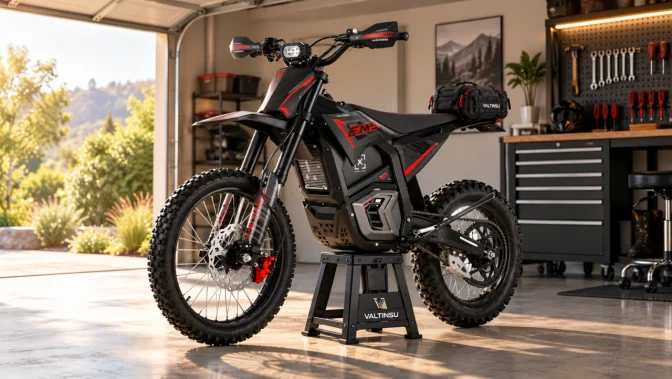
Electric Dirt Bike Ground Clearance vs Suspension Travel: What Each Number Means
Electric dirt bike ground clearance is the vertical space between the ground and the motorcycle’s lowest relevant chassis point, while suspension travel is how far the wheel and suspension can move through the designed stroke. Rider sag reduces available ride height before an obstacle is reached, so a large travel figure does not guarantee high clearance and high static clearance does not guarantee the chassis will stay clear on rough terrain.
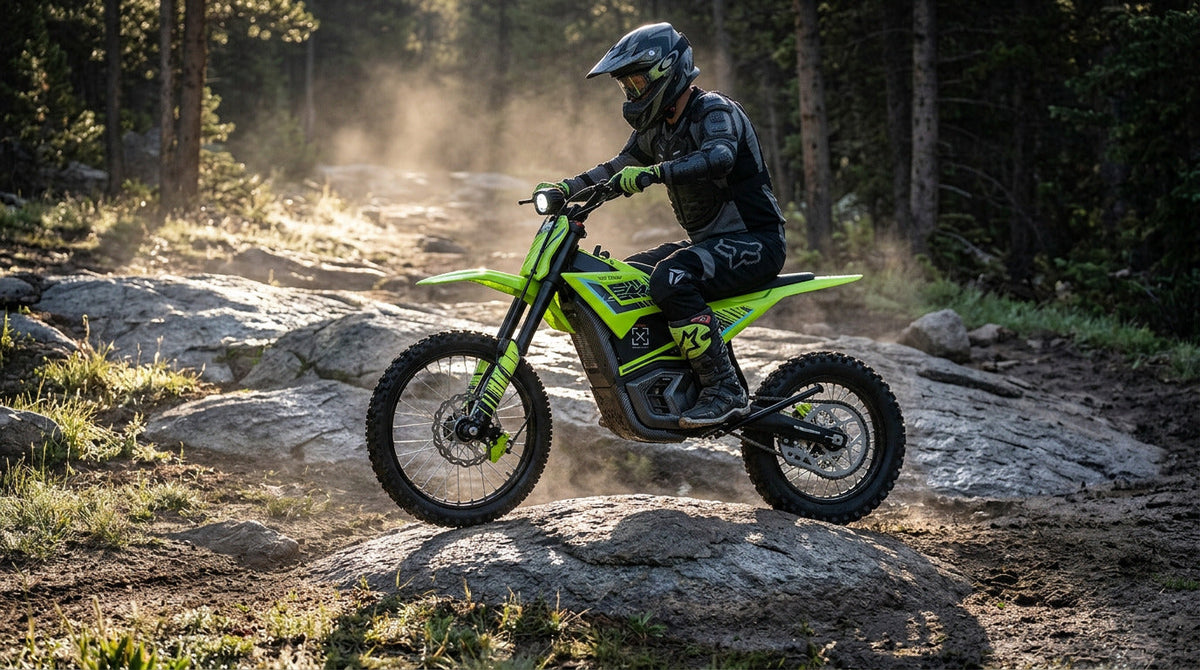
An adult rider approaches a rocky Colorado trail section with a raised center rock sitting between the wheels. Two electric dirt bikes could both publish 150 mm of front suspension movement and still place their motor, frame, battery enclosure or skid area at completely different heights above that rock.
The number describing how far the fork moves is not the number describing whether the chassis clears the obstacle. On an adult electric off-road motorcycle four separate measurements decide the outcome: static clearance, rider-loaded clearance, suspension sag and total suspension travel. Claims like "seven inches is enough" or "200 mm of travel handles any trail" collapse the moment you separate them.
Two Different Measurements
Ground clearance answers one question: how much vertical space exists below the motorcycle in the specified measurement condition? The reference point matters enormously, because the lowest fixed item might be the frame, a motor housing, a skid plate, a linkage, a chain guide, a footpeg bracket or other fixed hardware. Do not assume the motor is always lowest.
Suspension travel answers a different question: how far can the suspension move? It says nothing directly about how high the chassis sits. Foot controls, suspension parts, chain runs and wheels all occupy different positions as the motorcycle moves, so a moving component should not be used as the clearance figure unless the manufacturer defines it that way.
The rule follows from the definitions. Ground clearance is a position, suspension travel is a movement range, and the two cannot be added together. Location matters too: two motorcycles with identical vertical clearance can meet the same obstacle differently depending on whether their lowest point sits near the front wheel, at the chassis center or near the rear.
Static, Loaded and Dynamic Clearance Are Three Different Numbers

Static clearance is measured from level ground to the selected lowest point with the motorcycle in its documented measurement state. Rider-loaded clearance repeats that with the intended rider aboard in a neutral, repeatable position. An 80 kg adult settling onto the seat changes front ride height, rear ride height, the lowest-point height and chassis pitch all at once, so the clearance reduction is not simply the rear sag figure.
Sag is the amount the suspension settles from its extended state under motorcycle and rider load, and manufacturers distinguish static or free sag from rider sag using their own terminology for the specific suspension. When the motorcycle settles, part of the movement range is already in use: total travel becomes a sagged riding position, leaving remaining compression travel above the bottom and extension travel available for the wheel to drop. That sagged portion is not lost travel, it is the part already doing the job of holding you at riding height.
Dynamic clearance is different again. It is the instantaneous distance between chassis and terrain while braking, accelerating, crossing a bump, entering a depression or changing pitch, and it can be smaller than any garage measurement. An EM-5 Pro approaching a broad Colorado rock on level throttle sits in one state; the same chassis under braking a moment earlier places its front end somewhere else entirely. Sag can lower parts of the chassis relative to the ground, but the exact change depends on geometry and cannot be calculated from shock stroke alone.
Suspension Travel Is Not Shock Stroke
This distinction prevents the single biggest spec-reading error in the category. Front fork travel may be reasonably close to front-wheel movement depending on fork and chassis geometry. A rear shock is different, because its physical stroke is not automatically equal to rear-wheel travel: linkage ratio, swingarm geometry and mounting position can multiply that movement substantially.
The scale of the difference is easy to underestimate. Sur-Ron publishes both numbers for the Light Bee X, listing an 87 mm rear shock stroke alongside roughly 210 mm of rear-wheel travel. The linkage more than doubles the figure. So when a product page lists "rear suspension travel," confirm whether it means shock stroke or wheel travel before comparing anything, and never silently reinterpret one as the other.
This matters most with compact electric dirt bikes, whose published rear figures look far smaller than a full-size motorcycle’s. Valtinsu publishes rear figures as shock strokes, and the Valtinsu user manual page is the place to confirm what any given number describes for your exact model.
Obstacle Shape Matters More Than Obstacle Height

A breakover situation happens when the front and rear wheels sit on different sides of a raised feature and the chassis has to pass above it. Wheelbase, wheel radius, obstacle shape, lowest-point location, suspension compression, rider load, approach and chassis pitch all feed into whether that works. A tall narrow rock and a broad rounded rise of the same maximum height create quite different demands, because the broad feature can lift both wheels and bring the middle of the chassis closer to the crest.
Wheel size interacts without deciding the matter. A larger rolling radius can raise axle height and change obstacle rollover geometry, but chassis clearance depends on how the frame, motor, battery, skid structure, swingarm and suspension are positioned relative to those axles. The EM-5 uses a 14/12-inch wheel format while the EM-5 Pro and EM-5 Ultra use 17/14, and without measured clearance figures that difference cannot be converted into a clearance advantage.
Travel and wheel size also solve different problems. A large wheel with short travel and a small wheel with longer travel are both real design choices, and neither combination is automatically superior. Terrain, damping, mass, geometry, tire construction, speed and rider input decide the result, so a nominal "six-inch rock" never represents one universal chassis demand.
Front, Rear, Contact and Protection

Front suspension influences front-wheel impact response, steering attitude, braking pitch and chassis height at the front. Rear suspension influences rear-wheel impact response, traction, acceleration squat and rear chassis height. When one end compresses more than the other, chassis pitch changes, which can raise one low point while lowering another. More rear travel therefore does not mean more ground clearance, because travel is capacity for movement rather than a static ride-height guarantee.
Two events that get confused are worth separating. Chassis contact means a frame, motor guard, battery protector or skid area touches terrain. Suspension bottoming means the suspension reaches or approaches the end of its available compression. They can happen independently: a motorcycle can contact a broad rock without using much travel, and suspension can use most of its travel in a deep compression without the chassis touching anything. Scratches on a skid area are not proof of bottoming.
Protection and clearance are also different things. A skid plate or lower guard may shield the motor housing, frame, battery area and fasteners, while impact still transfers force into mounts, frame, motor structure and surrounding hardware. Clearance reduces the chance of contact; protection reduces exposure when contact happens. Neither is permission to hit rocks.
Measure It Yourself
Published numbers are a starting point, and your own measurement is better evidence for your bike. Use a flat hard surface, the exact motorcycle configuration, cold tire pressure per the manual, the battery installed, no cargo, the same 80 kg test rider in the same gear, the same measurement points and the same tool. Measure more than once, and repeat until the figure is consistent. MSF’s T-CLOCS checklist covers the tire, wheel, suspension and chassis condition that has to be sound before any of this means anything.

Blank record templates. No values supplied, because no measurement was taken for this article.
Record sag as a state rather than a target: a fully extended reference, a bike-only state where applicable, the rider-loaded state, front and rear measurements, and the manufacturer baseline. Preload, air pressure, spring specification, clicker settings and allowable adjustment all belong to the exact manual. WP Suspension makes the case for why setup matters at all, noting that a good suspension set-up helps riders keep control over rough and uneven terrain and lets the wheels maintain better contact with the ground, tailored to rider weight, riding style and terrain. That is an argument for measuring your own state, not for copying a mountain-bike sag percentage into a motorcycle.
EM-5, EM-5 Pro and EM-5 Ultra Suspension Matrix
|
Model |
Front figure |
Rear published figure |
Wheels |
Seat height |
Net weight |
Ground clearance |
|
EM-5 |
5.9 in / about 150 mm stroke |
1.6 in / about 40 mm stroke |
14 / 12 in |
28.3 in |
126 lb |
Measure or verify current official spec |
|
EM-5 Pro |
5.9 in / about 150 mm stroke |
2.0 in / about 50 mm stroke |
17 / 14 in |
31.5 in |
143 lb |
Measure or verify current official spec |
|
EM-5 Ultra |
5.9 in / about 150 mm stroke |
2.0 in / about 50 mm stroke |
17 / 14 in |
31.5 in |
143 lb |
Measure or verify current official spec |
Those suspension figures alone cannot rank the three models for obstacle clearance, which is exactly why the last column is honest rather than filled in. Two lessons sit inside the table. The EM-5 Pro and EM-5 Ultra share every chassis figure here, yet the Pro runs 60V, 5,600W and 177 lb-ft while the Ultra runs 72V, 8,000W, 203 lb-ft and 56 mph. More power changes how quickly the chassis can be loaded and how intense a terrain event becomes, and it creates no additional static ground clearance. The Pro also comes in Volt Green, which changes nothing dimensional.
The EM-5 against the EM-5 Pro makes the opposite point. The Pro’s larger wheel format and larger rear stroke suggest a different chassis package, and the EM-5’s lower seat, smaller wheels and lighter mass are a different package rather than a worse one. Without verified static and loaded clearance measurements, neither can be assigned a maximum obstacle height. Our EM-5 complete guide covers the rest of that platform.
Why Published Clearance Numbers Rarely Compare Cleanly
|
Model |
Published clearance |
Front travel |
Rear figure |
Evidence type |
|
Valtinsu EM-5 Pro |
Not published |
150 mm stroke |
50 mm stroke |
Manufacturer-published stroke figures |
|
Valtinsu EM-5 Ultra |
Not published |
150 mm stroke |
50 mm stroke |
Manufacturer-published stroke figures |
|
Sur-Ron Light Bee X |
270 mm |
200 mm travel |
87 mm stroke, about 210 mm wheel travel |
Published across current listings, varies by model year |
|
KTM Freeride E-XC (2023) |
Not published here |
WP XPLOR 43 fork |
260 mm rear travel |
KTM published specification for that model year |
Manufacturers differ in measurement condition, whether a rider is aboard, tire specification, suspension preload, which reference point counts as lowest, market version and model year. So 270 mm from one brand and 300 mm from another may not be an apples-to-apples comparison at all unless the methodology is known. Keep manufacturer-published, own-measured and rider-loaded figures in separate labeled columns, and never merge them.
Both competitors deserve credit on their own terms. Sur-Ron brings an established aftermarket, race and trail pedigree, deep owner knowledge and strong resale recognition, though its wheel format and peak power have both moved across model years, so check the current sheet. KTM’s Freeride E-XC is a full-size chassis with WP suspension and a dealer service network, and its 260 mm of rear travel shows how these figures scale on a full-size off-road motorcycle. It is a useful reference rather than a price peer, and a bigger number does not make it the right bike for every rider.
Match the Whole Chassis to Your Terrain

Seat height and ground clearance are separate questions that buyers routinely merge. Seat height sets rider-to-ground and cockpit fit; ground clearance sets lower-chassis distance from terrain. A taller seat can sit above modest clearance, and a lower seat can coexist with useful under-chassis space depending on frame layout, battery placement, wheel diameter and suspension geometry. Nobody short should be steered toward low clearance on fit grounds.
Terrain changes the priorities rather than the ranking. Smooth fire roads reward predictable suspension, stability and enough clearance for shallow ruts and loose rock, where extreme travel is unnecessary. Rooted and rocky singletrack shifts weight onto loaded chassis clearance, wheel rollover, suspension control, low-speed line choice and protection of low components. Repeated rough terrain adds travel, damping, thermal consistency, chassis protection, rider fatigue and enough clearance under compression. None of those produces a universal obstacle height or travel threshold.
So resist the arithmetic of "my trails have seven-inch rocks, so I need eight inches of clearance." Evaluate obstacle height with width, shape, line, wheel radius, wheelbase, loaded clearance, suspension state, lowest chassis point, rider ability and legal trail conditions. Ground clearance helps qualify a chassis; it does not establish a maximum safely rideable obstacle. And while tire, suspension, ride-height or component changes can alter clearance, they also change steering geometry, wheelbase relationships, tire clearance, chain alignment, suspension behavior, braking, seat height and stability, so fork-height changes, shock-length changes, linkage swaps, preload tricks, oversized tires and fabricated skid spacing all belong to exact model documentation and manufacturer-approved components rather than to a shopping decision. More reading sits in our riding guides.
Conclusion
Ground clearance is chassis-to-ground space and suspension travel is available suspension movement. Sag uses part of that movement and changes loaded ride height, so static clearance can differ from both rider-loaded and dynamic clearance. Wheel size and wheelbase affect obstacle geometry, the location of the lowest point matters as much as its height, and chassis contact and suspension bottoming are separate events.
Bigger numbers do not automatically mean better trail fit. Compare the EM-5 Pro as a complete package using chassis dimensions, suspension figures, wheels, rider load and the terrain you actually ride rather than one isolated specification.
FAQS
What is electric dirt bike ground clearance?
It is the vertical distance from the ground to the lowest relevant chassis point, whether that point is manufacturer-defined or measured. Measurement condition matters, because whether a rider is aboard, tire specification and suspension state all change the figure you end up with.
What is the difference between ground clearance and suspension travel?
Ground clearance is a position, describing how much space sits below the chassis. Suspension travel is a movement range, describing how far the suspension can move. They measure different things, so they cannot be added together or substituted for each other.
What is a good amount of ground clearance for a dirt bike?
There is no universal figure. Match clearance to the motorcycle’s geometry, its rider-loaded state, your terrain, wheel size, wheelbase, which component sits lowest, and the shape of the obstacles you actually cross rather than shopping for the largest published number.
Is 7 inches of ground clearance good?
Seven inches alone cannot determine trail capability. Without knowing the measurement condition, whether a rider was aboard, which component is lowest and what terrain you ride, the number describes very little about how the chassis will behave over obstacles.
Is 120 mm of ground clearance enough?
That is roughly 4.7 inches, and whether it is enough depends entirely on context. Terrain, obstacle shape, loaded clearance, wheel size, wheelbase and the location of the lowest chassis point all matter more than the isolated figure does.
Does suspension sag reduce ground clearance?
Settling under load can lower parts of the chassis, yes. The exact reduction depends on front and rear geometry and how chassis pitch changes, so it cannot be calculated from a rear sag measurement or a shock stroke on its own.
Does more suspension travel mean more ground clearance?
No. Travel and chassis position are separate design parameters. A motorcycle can offer substantial suspension movement while still placing its motor, frame or skid area relatively low, and more travel can also allow larger dynamic chassis movement.
How do you measure ground clearance on an electric dirt bike?
Use the manufacturer specification first. For your own evidence, measure on level ground from the surface to the documented lowest point, with cold tire pressure per the manual, and label clearly whether the reading is unloaded or rider-loaded.
Can larger tires increase electric dirt bike ground clearance?
A larger rolling radius may raise axle and chassis height, but it also changes geometry, clearances and compatibility. Any size change has to be verified against the motorcycle specification rather than treated as a straightforward clearance upgrade.
Can you increase an electric dirt bike’s ground clearance?
Changes to tires, suspension, ride height or components can alter clearance and can also affect steering, wheelbase relationships, chain alignment, braking, seat height and stability. Use manufacturer-approved dimensions, components and documentation rather than improvised geometry changes.
Sources
- WP Suspension, The Importance of a Good Suspension Set-Up in Enduro
- Motorcycle Safety Foundation, T-CLOCS Pre-Ride Inspection Checklist
- Motorcycle Safety Foundation, DirtBike School
- Motorcycle Safety Foundation, Tips & Practice Guide for the Off-Highway Motorcyclist
- R. S. Sharp, The Stability and Control of Motorcycles (open access)


Looking for something else?
Electric Dirt Bike Replacement Parts Availability: What Buyers Should Verify Before Ordering
LEARN MORE
How to Check an Electric Dirt Bike for Safety Recalls by Model and Serial Number
LEARN MORE
How to Choose an Electric Dirt Bike Repair Shop: Questions to Ask Before Service
LEARN MORE
How to Lift a Fallen Electric Dirt Bike Without Hurting Yourself or the Bike
LEARN MORELooking for something else?
Electric Dirt Bike Fall Riding on Wet Leaves: Grip, Hidden Obstacles and Braking
LEARN MORE
Electric Dirt Bike Trailside Power Loss: Recovery Plan When the Battery Is Dead
LEARN MORE