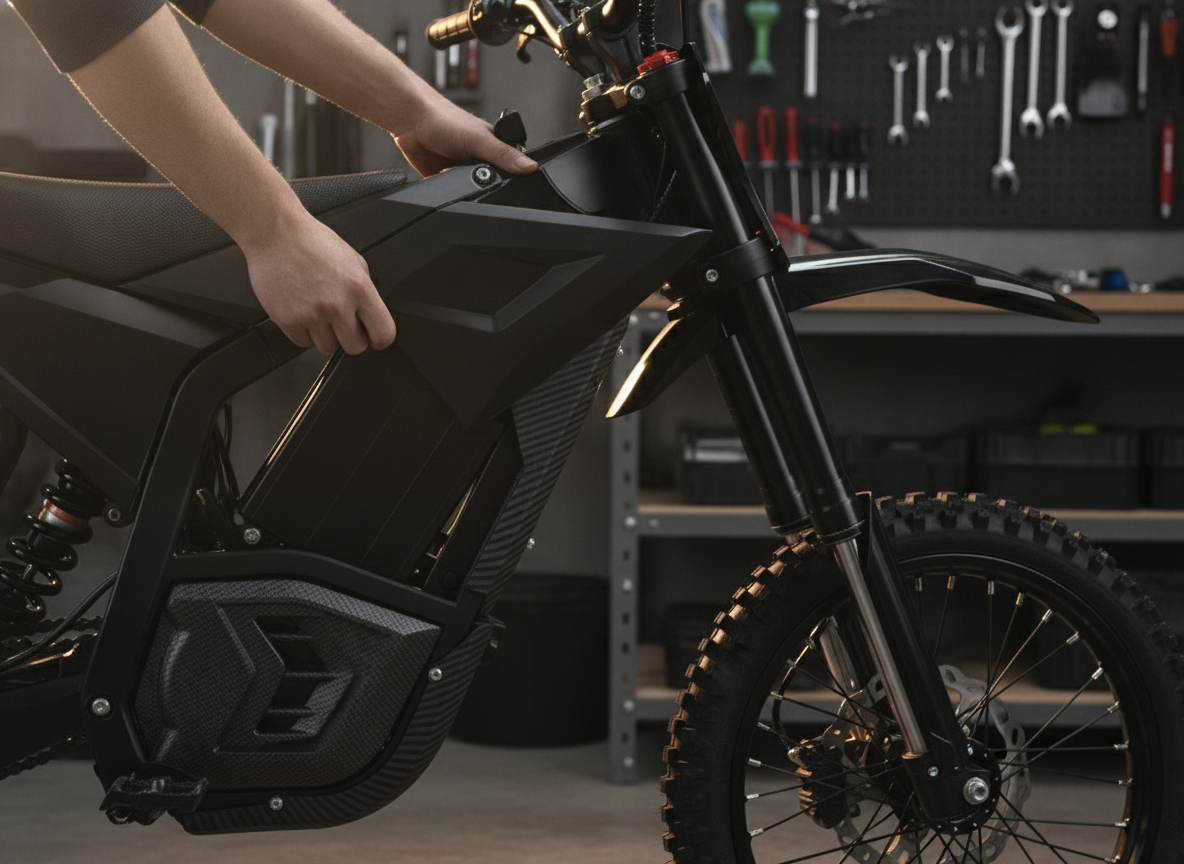
Electric Dirt Bike Battery Life: How Long It Lasts and How to Extend It
Prices and lifespan numbers below track the publicly listed 2026 specs of the bikes people actually ride, Sur-Ron, Talaria, Valtinsu, and the cell suppliers behind them. We re-check them on a schedule.
Three to five years. That is electric dirt bike battery life in one breath, or 500 to 1,000 full charge cycles before the pack starts to fade. The number holds across the adult off-road bikes people actually ride. On a single charge, you get anywhere from 30 minutes of hard track laps to a couple of hours of easy trail.
The headline is the easy part, though. How fast the pack ages comes down almost entirely to how you charge and store it, not how hard you ride. And when it finally fades for good, the replacement is the bill nobody warns you about. A 72-volt pack can cost more than a decent used bike.
So we pulled the real numbers into one place. How long it lasts. How far it goes by riding style. What a new pack actually costs by voltage. And the charging habits that decide whether you get three years out of it or eight.
How Long Does an Electric Dirt Bike Battery Last?
Three to five years for most riders. Counted in charge cycles, though, not calendar pages. Figure 500 to 1,000 full cycles before the pack slips under about 80 percent of where it started, and 80 percent is the line most people call worn out. Weekend-only riding stretches you past five years, easy. Hammer it daily and you burn through it a lot quicker.
Chemistry caps all of it. Nearly every adult e-dirt bike runs nickel-manganese-cobalt cells. NMC, the same chemistry that 3-to-5-year number quietly assumes, and yes, Sur-Ron and Talaria both use it. A few bikes go lithium iron phosphate instead. Lasts far longer on paper, but it weighs more and stores less, so you almost never see it on a performance e-moto.
|
Battery type
|
Typical cycle life
|
Found on
|
|
Li-ion (NMC)
|
500-1,000 cycles to ~80%
|
Most e-dirt bikes (Sur-Ron, Talaria, Valtinsu)
|
|
LiFePO4 (LFP)
|
3,000-5,000 cycles
|
Rare on e-motos; heavier, lower energy density
|
|
Lead-acid
|
200-300 cycles
|
Cheap kids ride-ons only
|
Takeaway is simple. If your bike is a real adult e-dirt bike, you are on the 500-to-1,000-cycle clock, and how you treat the pack pushes you toward one end of that or the other.
Charge Cycles vs Years: What a Cycle Really Means
One full 0-to-100 percent discharge. That is a cycle. Not a plug-in. Charge from 60 back up to full and you spent maybe four-tenths of one, not a whole cycle. Tiny distinction. Big payoff, because shallow charging like that is exactly how a pack outlives its rated cycle count.
So a 1,000-cycle rating is not 1,000 rides. It is 1,000 full drains' worth of energy, spread across however you happen to ride. Most owners reach the 500-to-1,000 band in three to five years. Ride less than that, or charge in little top-ups, and the years pile up well past it. The timeline below plots that 500-to-1,000-cycle window against the 3-to-5-year mark, with the 80 percent line that calls the pack worn.
Lithium-Ion vs LiFePO4: Which Lasts Longer?
LiFePO4 wins on raw lifespan. Not even close, honestly. Those cells go 3,000 to 5,000 cycles where a standard NMC pack taps out around 1,000 to 2,000. Run them to 500 cycles in the lab and LFP still holds about 94 percent; NMC is down nearer 82 by then. So on paper, LFP is the tougher chemistry.
Almost no e-dirt bike uses it, though. LFP is heavier and holds less energy per pound, and a trail bike lives or dies on weight, so builders grab the lighter, denser NMC and eat the shorter life. The lever you actually control is cell quality inside that NMC pack. Branded Samsung or Panasonic cells age slower, and more predictably, than the no-name cells in the cheap bikes. The chemistry label matters less than the cells hiding behind it.
How Far Can It Go on One Charge?

Alt: Electric dirt bike on a moderate trail ride.
Range swings on how you ride, harder than on any other factor. The same pack that returns 40 miles on a mellow trail can drain in 15 under wide-open throttle. Real-world testing of a Sur-Ron Light Bee X lays the spread out, and it is the honest picture for the whole class. NiceCNC logged it by riding mode:
|
Riding style
|
Real range (Sur-Ron Light Bee X)
|
What it looks like
|
|
Aggressive / wide-open
|
15-25 miles
|
Track laps, hard acceleration, deep dirt
|
|
Trail / moderate
|
22-35 miles
|
Steady cross-country on packed dirt
|
|
Eco / steady
|
37-43 miles
|
Flat, gentle throttle, lower speed
|
Bigger packs reach further. A Talaria on a 72-volt, 40Ah battery is rated up to 50 or 60 miles of moderate riding, per Talaria's own spec, though hard riding roughly halves that. In time terms, figure on 30 to 45 minutes of hard track work or one to two hours of trail from a full charge. That is an estimate off the mileage, not a promise, but close enough to plan a day around.
Real-World vs Spec Sheet Range
The number on the listing is a best case. Light rider, flat ground, gentle throttle, fresh pack, mild day. Strip those away and the real figure drops, sometimes by a third. Wind, hills, soft dirt, low tire pressure, a heavier rider, cold air, they all pull from the same battery.
So read the spec as a ceiling, not a promise. If you spend your weekends carving the same loop wide-open, plan off the aggressive column and assume the low end. If you ride a long, mellow trail through the woods all day, you can lean nearer the moderate figure but still hold back 30 to 40 percent of charge for the ride out. Running a pack to zero miles from home is how a good day turns into a long push.
Does Higher Voltage Mean More Range?
Not directly. Trips up a lot of buyers, this one. Range lives in watt-hours, and watt-hours are voltage times amp-hours, not voltage by itself. Voltage mostly buys power and top speed. Amp-hours are what buy the distance.
Run the math and it clicks. The 72V Samsung-cell EM-5 Ultra runs a 72V 25Ah pack. Multiply it out, 1,800 watt-hours. A 60V 27Ah pack lands at 1,620. The higher-voltage bike is the quicker, harder-pulling one, sure, but the real range gap is those watt-hours, not the headline voltage. So shop on the multiplication. A flashy 72V badge with skinny amp-hours can run shorter than a humbler 60V pack carrying more capacity.
This one comes up on every forum thread. Someone insists their 72V build has to outlast and outrun a 60V bike because the number is bigger. It does not work that way. Voltage is the punch off the line. Watt-hours are the distance, and lifespan rides on cells and charging habits, not the voltage badge on the side.
|
Myth: "A 72V battery always lasts longer and goes further than a 60V one."
Reality: Range is watt-hours, voltage times amp-hours. A 72V pack with skinny amp-hours can fall short of a 60V pack carrying more capacity, and cycle life tracks the cells, not the voltage.
|
What Kills Electric Dirt Bike Battery Life?

Alt: Electric dirt bike kept out of direct heat to protect the battery.
Full charges. Deep drains. Heat. Cold. Those four age a pack faster than the riding ever does, and botch them and a 1,000-cycle battery starts behaving like a 300-cycle one. The biggest lever by a mile? How deep you cycle it.
The numbers are blunt. Battery University, the standard reference on lithium care, measured how depth of discharge alone changes cycle life on NMC cells. The gap between a 20 percent top-up and a 100 percent drain is not subtle, as the table lays out:
|
Depth of discharge
|
Approx. cycles before 70% capacity
|
|
100% (full drain every time)
|
~300 cycles
|
|
80%
|
~400 cycles
|
|
50%
|
~1,200 cycles
|
|
20% (shallow top-ups)
|
~2,000 cycles
|
Heat does the quiet damage. Leave a fully charged pack a year at room temperature and it keeps about 80 percent of capacity; leave it at 40 degrees Celsius and it keeps maybe 65. Freezing cold hurts too, both in storage and while charging. The pattern writes itself. Full, hot, and empty are the three states to keep it out of.
Think of it like a rubber band. Charge to 100 every day and leave the bike baking in a hot garage and you cannot see the harm at first. The pack still rides fine. Then year four shows up, the range is gone, and the elasticity never comes back. A few of those habits do most of the killing, and we broke them down in five habits that quietly kill range.
Temperature and Climate: The Hidden Range Killer
Cold and heat hurt a battery in two different ways, and the difference matters. Cold is temporary. Ride in near-freezing air and the pack hands back maybe 20 to 30 percent less range that day, then returns to normal once it warms. Annoying, not permanent.
Heat is the one that scars. High temperature does not just shrink today's range, it ages the cells for good, and a pack stored hot and full loses real capacity it never gets back. So a cold winter ride costs you a short day. A hot summer shed costs you battery life. Charge a cold pack only after it warms to room temperature, and never leave a full battery cooking in direct sun or a closed-up garage.
How to Make the Battery Last Longer

Alt: Electric dirt bike battery charging indoors at room temperature.
Charge to about 80 percent for regular rides, and stop draining below 20. That single habit roughly doubles cycle life over charging full and running it flat every time. Park it around 40 to 60 percent if it is sitting for weeks. Keep it clear of heat and hard cold. Our own write-up on five habits that quietly kill range covers the rest, but the short version fits in a few lines.
-
Stop at ~80 percent for daily use. Save the full 100 percent for days you actually need every mile. Lower peak voltage, more cycles in the bank.
-
Never let it sit empty. Recharge soon after a ride. A pack left flat for weeks can sink into a deep discharge it never fully recovers from.
-
Cool and partial for storage. Half charge, indoors, somewhere 50 to 86 degrees Fahrenheit. Recheck every few months and top it back to 50 or 60.
-
Warm it before you charge. Let a cold pack reach room temperature first, and never charge below freezing.
-
Stick to the bike's own charger. Off-brand or over-spec chargers push the cells harder than the BMS plans for.
|
Myth: "Charging it more often than the next rider wears the battery out faster."
Reality: The number of plug-ins barely matters. Where you charge it and where it sits, hot or cool, full or part-charged, is what ages the pack. Small frequent top-ups are gentler than draining it flat and refilling.
|
Battery Management Systems (BMS): Why It Matters for Longevity
Every decent lithium pack ships with a BMS, the small board that polices the cells. It balances them so no single cell runs ahead of the pack, cuts the charge before anything overcharges, and watches temperature so the battery is not charging when it is too hot or too cold. Quietly, it is doing most of the work that keeps the pack alive.
Which is also why the charger matters more than people think. A cheap or over-spec charger can push past what the BMS is tuned for, and on a no-name pack a weak BMS lets cells drift out of balance until the whole thing fades early. Run the bike's own charger, or a quality smart charger rated for the pack, and let the BMS do its job. It is the difference between a pack that ages evenly and one that loses a single sick cell and drags the rest down with it.
Does Fast Charging Hurt the Battery?
A little, over the long haul, and it comes down to heat. Rapid chargers push current in faster, the cells warm up, and heat is the thing that wears lithium out. Occasional quick top-up before a second ride? Fine, no real harm. Lean on a fast charger every single day and your pack fades sooner than the guy who charges slow and steady.
Rule we follow: standard charger for the overnight routine, fast charger only when you genuinely need the bike back inside 90 minutes. And let a hot pack cool a few minutes after a hard ride before it ever sees the charger. Charging heat piled on top of riding heat is the worst combination there is.
Signs Your Battery Is Wearing Out
Range is the first thing to go. A pack that used to do 35 miles quietly settling at 25 is the clearest early warning, long before anything dramatic happens. Watch for a few other tells too.
-
Shorter rides on a full charge. Steady capacity loss is the number-one symptom of an aging pack.
-
It charges to full faster than it used to. Less capacity to fill, so the charge time drops. A subtle one.
-
The BMS starts cutting power. Sudden drops to limp mode or shutoffs under load mean cells or the management board are struggling.
-
Any swelling, heat, or smell. Stop riding and stop charging. A puffed or hot pack is a safety issue, not a wear issue, and it needs professional eyes.
Catch the slow range loss early and you can plan a replacement on your terms. Ignore it until the bike strands you, and you are buying a pack in a hurry at full price.
What Does a Replacement Battery Actually Cost?

Alt: Buyer inspecting a used electric dirt bike battery before purchase.
Here is the part the spec sheets skip. A replacement pack runs from about $800 to well over $3,000, and the price climbs steeply with voltage. For a lot of owners, the battery is the single most expensive part of the entire bike, which is why the cost blindsides people around year four.
Current US pricing, by system:
|
Pack system
|
Typical replacement cost
|
Notes
|
|
48-60V (Sur-Ron class, OEM)
|
~$800-1,200
|
Stock 60V 40Ah pack
|
|
60V (Talaria, OEM)
|
~$1,150-1,950
|
Depends on Ah and model
|
|
72V / 40Ah (aftermarket)
|
~$1,070-2,400
|
Often needs a matching controller too
|
|
81V (performance builds)
|
~$2,800-3,600
|
Race-oriented, high Ah
|
One hidden cost worth flagging hard. Bump a Sur-Ron or similar from 60 volts up to a 72- or 81-volt aftermarket pack, and you usually need a new controller too. Another $1,100 to $1,200, because the stock electronics were never wired for the higher voltage. That is how a "battery upgrade" quietly turns into a $2,500 project. Like-for-like is the cheaper road every time.
Because the pack is the priciest part on the bike, a lot of owners hit year four and start running the math the other way. Replace the battery, or just replace the bike? That is the moment build quality earns its keep. A bike that started with branded high-capacity cells, more watt-hours, and a real BMS reaches that crossroads later and in better shape, which is the whole reason a heavier-spec pack is worth paying for up front instead of chasing the cheapest sticker.
Battery Health and Resale: Will It Still Hold 80 Percent?
Usually it will, if the last owner cared. A quality lithium pack holds roughly 80 percent of capacity after 500 to 1,000 cycles, which most riders reach in two to three years of regular use. That 80 percent line is the one buyers care about, because below it the range drop gets obvious on the trail.
Storage history is the real tell. A pack kept at 50 percent charge holds about 96 percent of its capacity after a year of sitting; one stored full holds only about 80, per lifespan testing. So when you shop a used e-dirt bike, the cycle count is only half the question. How did the last owner charge and store it? Ask. A bike babied at partial charge in a cool garage is worth more than the same model left full in a hot shed, identical age or not.
A quick checklist for the test ride:
-
Log the real range. Ride it, watch the actual miles against the state of charge, and compare that to what the model is rated for new. A big gap means a tired pack.
-
Ask for the charging story. Stored full in a hot shed or kept part-charged in a cool garage? The honest answer tells you more than the odometer.
-
Use the spec as a yardstick. Hold the measured range against the maker's nominal figure. A Valtinsu EM-5 Pro is rated around 59 miles, the EM-5 Ultra around 75, so a used bike landing well under its own number has likely lost capacity.
What Does the Warranty Actually Cover?
Less than you would hope. Most adult e-dirt-bike battery warranties run one to two years, and they cover manufacturing defects. Not the slow capacity fade that counts as normal wear. So a pack drifting from 100 percent down to 75 over two years? Doing exactly what it should. Not a warranty claim.
Before you buy, read three things in the warranty. How long it actually runs. Whether it covers capacity loss past a stated threshold or only outright failure. And what voids it, because aftermarket chargers, modifications, and water damage usually do. The honest move is to treat the battery as a wear part with a known lifespan, budget for an eventual replacement, and let the warranty cover the early defect that occasionally slips through.
Adult Off-Road vs Kids: Battery Expectations Differ
Kids' ride-on dirt bikes and adult e-motos are not the same conversation, not even close. The cheap kids bikes often run small sealed lead-acid or low-cell lithium packs, good for maybe 45 minutes a charge and a year or two of life. Adult off-road bikes carry real high-capacity lithium and the full 3-to-5-year, 500-to-1,000-cycle story.

Alt: VALTINSU EM-5 Pro Green Electric Dirt Bike
On the adult side, pack quality is where the longevity actually lives, and it tracks with the cells. Valtinsu's 60V geared-motor model, the EM-5 Pro, runs a 60V 27Ah pack rated around a 59-mile range, while the EM-5 Ultra steps up to 72V Samsung cells for as much as 75. Branded cells matter here, because the unbranded packs are the ones that fade early and strand you. Want to line up the off-road range by spec? That watt-hour number is what to compare, right alongside the warranty terms.
Choosing a Battery for Your Riding Style (2026)
Most people shop battery life backward, picking a number off a spec sheet before they think about how they ride. Flip it. Start with the riding, and the battery that fits, and the lifespan you should expect, fall out of that.
|
Riding style
|
Battery to look for
|
What lifespan feels like
|
|
Track / aggressive
|
1,500Wh+, 72V for the punch
|
Cycles burn fast; plan a replacement sooner
|
|
Trail / all-day
|
1,600-2,000Wh, 60-72V
|
The sweet spot, an easy 4-5 years of weekends
|
|
Commute / light
|
1,000-1,500Wh, 48-60V
|
Shallow daily cycles, longest life of the three
|
Read the watt-hours, not the voltage badge, then match the warranty to it. As a scale to measure against, Valtinsu's 60V geared-motor model the EM-5 Pro lands at 1,620Wh, and the 72V EM-5 Ultra at 1,800. Use whatever bike you are eyeing the same way: multiply volts by amp-hours, then ask how the pack is built underneath.
US Riders: Climate and Storage Tips
Where you live changes how you should treat the pack, and the US runs the full range.
-
Hot states (California, Arizona, Texas): Heat is the permanent killer, so keep the bike out of the sun and out of a closed-up garage that bakes all afternoon. Indoors or shaded, every time, and never store it full in summer.
-
Cold states (the snow belt): Over winter, store the pack indoors at room temperature, charged to about 50 to 60 percent, and top it back up every couple of months. Let it warm before you charge, and never charge below freezing.
One more local angle people skip. A dead lithium pack is not regular trash. In the US it goes to an e-waste recycling drop-off, a battery recycler, or back to the dealer, never the curbside bin, both because it is the law in a lot of states and because a damaged lithium cell is a genuine fire risk. Check your state or local EPA page for the nearest drop-off before you toss anything.
Reviewed by the Valtinsu Editorial Team
Written by the Valtinsu Editorial Team, which tracks Sur-Ron, Talaria, and Valtinsu owner feedback and real-world range reports across the e-dirt-bike community. Technical review: every lifespan, depth-of-discharge, and charging figure here is cross-checked against Battery University's BU-808 reference and the lifespan testing published by EVELO and GritShift. Prices reflect publicly listed US figures as of June 2026.
FAQs
How long will a 1,000-cycle battery last?
Roughly 3 to 5 years of normal riding. One cycle is a full 0-to-100 percent discharge, so 1,000 cycles is 1,000 full drains' worth of energy, not 1,000 rides. Partial top-ups only count as fractions. That is why easy charging pushes it well past five years.
Can electric dirt bike batteries last 10 years?
Yes, but only with careful use. Eight to 10 years takes shallow charging, storing the pack part-full, and keeping it clear of heat and freezing cold. Hard daily riding and full-drain habits? That cuts it to 3 years or less. In practice, plenty of riders swap the pack early anyway, around year six or seven, once range anxiety on the trail outweighs the cost of a fresh battery.
-
Charge to ~80%, avoid 0%
-
Store cool at 40-60%
-
Hard use shortens it sharply
What is the battery life of an electric bike?
About 3 to 5 years, or 500 to 1,000 charge cycles. Same band as an electric dirt bike, since both run lithium-ion. Bigger packs with better cells, charged gently, land at the high end. Cheap packs and abuse drag you to the low end.
How long does an electric dirt bike battery last in a day?
Anywhere from 30 minutes to 2 hours on a charge. Wide-open track riding drains a full pack in 30 to 45 minutes. Steady trail riding on a light throttle usually buys 1 to 2 hours. Terrain, speed, rider weight, they all move it.
How long does it take to charge an electric dirt bike?
Around 3.5 to 4 hours from empty on a normal wall outlet. A fast charger gets you to about 80 percent in roughly 1.5. Cold slows the whole thing down, and you never charge a pack below freezing.
How much does a replacement electric dirt bike battery cost?
Roughly $800 to $3,600, depending on voltage. A 60V Sur-Ron-class pack runs $800 to $1,200. A 72V aftermarket one, $1,070 to $2,400. High-voltage 81V builds cost more again. And a voltage upgrade usually drags in a new controller, another $1,100-plus. If you want to see how capacity and nominal range track across voltages, you can line up the off-road range by spec.
-
60V OEM: ~$800-1,200
-
72V aftermarket: ~$1,070-2,400
-
Upgrades may need a controller (+$1,100)
Does fast charging ruin an e-dirt-bike battery?
Not from occasional use. Daily fast charging, though, shortens its life. Rapid chargers add heat, and heat is what wears lithium cells down over time. Standard charger for the overnight routine, fast charger only when you genuinely need a quick turnaround.
How do I know if my electric dirt bike battery is dying?
Lost range first. A pack that used to do 35 miles now stopping at 25. After that, faster-than-normal charging, sudden power cutoffs under load, and any swelling or heat. Catch the range drop early and you plan a replacement instead of getting stranded on the trail.
Last updated: June 2026. Figures verified against Battery University (BU-808), EVELO, GritShift, and NiceCNC.
Sources
- Battery University (Cadex), BU-808: How to Prolong Lithium-Based Batteries
- Dirt Bike Magazine, Sur-Ron Ultra Bee Review (2024)
- GritShift, Lithium Battery Care for Electric Dirt Bikes (2026)
- EVELO, Understanding E-Bike Battery Lifespan and Maintenance (2026)
- NiceCNC, Real-World Range of the Sur-Ron Light Bee X (2026)
- Talaria, Sting MX5 Pro Specifications (2026)


Looking for something else?
Electric Dirt Bike Replacement Parts Availability: What Buyers Should Verify Before Ordering
LEARN MORE
How to Check an Electric Dirt Bike for Safety Recalls by Model and Serial Number
LEARN MORE
How to Choose an Electric Dirt Bike Repair Shop: Questions to Ask Before Service
LEARN MORE
How to Lift a Fallen Electric Dirt Bike Without Hurting Yourself or the Bike
LEARN MORELooking for something else?
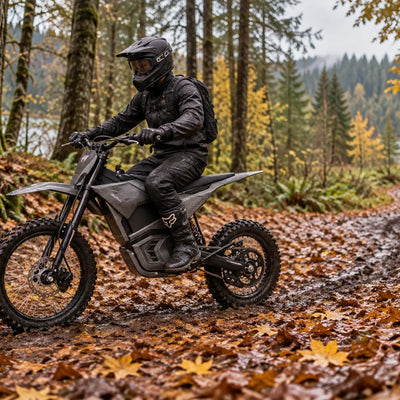
Electric Dirt Bike Fall Riding on Wet Leaves: Grip, Hidden Obstacles and Braking
LEARN MORE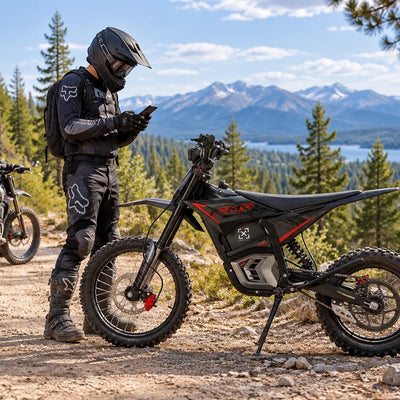
Electric Dirt Bike Trailside Power Loss: Recovery Plan When the Battery Is Dead
LEARN MORE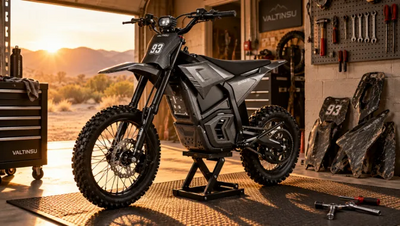
Electric Dirt Bike Plastics Replacement Guide: Fitment, Color Kits and Install Order
LEARN MOREYou may also like
VALTINSU EM-5 Off-Road Electric Dirt Bike
€1.299,00
€1.599,00
VALTINSU EM-5 Pro Off-Road Black Electric Dirt Bike
€1.999,00
€2.199,00
VALTINSU EM-5 Pro Green Electric Dirt Bike
€1.999,00
€2.199,00
VALTINSU EM-5 & EM-5 Pro Combo
€3.148,00
€3.298,00