

Street Legal Dirt Bike: Laws, Conversion & Rider Guide
Tyler dropped $600 on a lighting kit last spring. Bolted it onto a used 450, rode straight to the DMV, and waited in line feeling pretty good about himself. He walked out without a plate. The title killed it in three words: “off-highway use only.”
Nobody puts that part in the YouTube videos. A street legal dirt bike — one you can register, plate, and legally ride on a road — isn't a dirt bike wearing lights. It's a machine the law already counts as road-built. Big difference. Whether you're eyeing a gas dual-sport or an Adult Electric Off-Road Motorcycle like the ones Valtinsu makes, the thing that decides your fate isn't the motor. It's a form.
|
Quick answer
A street legal dirt bike is a dual-sport motorcycle — built at the factory with DOT lights, mirrors, a horn, road tires, a road VIN, and the registration to match. A pure off-road dirt bike? Not street legal, not by default. You can sometimes convert one, but only if the title plays along and your state allows it. Most electric dirt bikes, Valtinsu's included, are off-highway vehicles. They stay on the dirt.
|
What Makes a Dirt Bike Street Legal?
A street legal dirt bike is the one the DMV will hand you a plate for. Riders call it a dual-sport. It's a motorcycle engineered for pavement and dirt both, and it ships road-ready off the showroom floor. Honda CRF450RL. KTM 500 EXC-F. They roll out with everything the law wants, so you register, insure, and go.

A motocross or pure off-road bike is something else entirely. No signals. No mirrors. Knobby tires that won't survive an inspection, and a title that often blocks road registration before you even start. Brilliant on a track. Illegal the second you touch a public street.
Street legal vs off-road only — the real divide
It isn't about speed, which surprises people. A 90-mph race bike can be illegal on the road while a 30-mph dual-sport is fine. The split comes down to one thing: did the manufacturer build and certify the bike for the highway, and does it carry the gear to prove it.
And this is where riders burn money. Bolting lights onto an off-road bike doesn't promote it to dual-sport. If the VIN and title read “off-road use only,” plenty of state DMVs won't register it — doesn't matter what you installed. The paper wins. Every time.
How the law actually sorts your bike
Classification happens at the state level, off the bike's design and title — not off whatever you bolted on last weekend. The USDA Forest Service says it without flinching: electric motorcycles like Sur-Ron and Talaria are off-highway vehicles, not e-bikes or mopeds. Valtinsu's bikes sit in that same bucket. Three categories cover nearly everything you'll run into:
|
Classification
|
Public Roads?
|
What It Means
|
|
Dual-Sport Motorcycle
|
Yes — if registered
|
Factory road-built with DOT gear, road VIN, insurance, Class M license
|
|
Off-Highway Vehicle (OHV)
|
No
|
Most off-road and electric dirt bikes, including Valtinsu EM-5 and EM-5 Pro
|
|
Converted Off-Road Bike
|
Sometimes
|
Only if the title allows it and the state accepts the conversion
|
And no — an electric dirt bike isn't an e-bike. A pedal-assist e-bike caps out near 750W and 28 mph and lives in the bike lane. The EM-5 Pro runs 4800W peak at 43 mph, no pedals anywhere. Ride it on a road like it's an e-bike and what you're actually riding is an unregistered motorcycle. Cops know the difference.

Required Equipment for a Street Legal Dirt Bike
Every state keeps its own list. Strip them all down, though, and the same core items show up at almost every DMV counter before they'll plate a converted off-road bike. Miss one item and the inspection ends right there. Here's the short version, then the detail:
Lights, mirror, horn, road tires, a speedometer, a plate mount, the right VIN, insurance, and a Class M license. That's the whole game. Now the parts that trip people up:
-
DOT-compliant lighting — headlight with high and low beam, taillight, brake light, and front and rear turn signals. Off-road trail lamps don't count.
-
Mirrors — one at minimum. Two in a lot of states.
-
An audible horn — heard from about 200 feet. Off-road bikes almost never ship with one.
-
DOT-approved tires — knobbies fail. Plan on a full tire swap.
-
A speedometer reading in MPH.
-
A license plate bracket with a plate light.
-
A road-recognized VIN — the one that quietly ends most conversions. If the title says “off-road use only,” the DMV can wave you off regardless of what's bolted on.
-
Registration, title, and liability insurance.
-
A Class M motorcycle license or endorsement.

|
The VIN problem
The hardware's the easy part — a full conversion kit runs $300 to $700. The title is the wall. If the manufacturer's paperwork says “off-road use only,” a state like California turns down road registration flat. So call your DMV with the exact VIN before you spend a dime on parts. One call. It saves a few of them.
|
|
Valtinsu EM-5 — Adult Electric Off-Road Motorcycle
48V geared motor | 3,840W peak | 190 N·m torque | 37 mph | IPX6 | Three ride modes | Age 13+
Built for trail riding on private land, OHV parks, and designated off-road areas — not public roads. The geared motor delivers its torque low in the rev range, which is exactly where a newer rider needs it on a tight climb.
From $1,259 USD | Free U.S. shipping | 3–7 day delivery
|
Can You Convert a Dirt Bike to Street Legal?
Maybe. That's the honest answer, and it forks two ways depending on what's in your garage.
Converting a gas dirt bike
Riders plate gas off-road bikes all the time. You add a street-legal kit — headlight, taillight, brake light, horn, mirrors — throw on DOT tires, pass an inspection, and walk away with a title the DMV signs off on. Sounds clean. The catch is almost always the VIN. A lot of off-road models carry titles stamped for off-road use only, and you can't paperwork your way around that with a parts swap.
Converting an electric dirt bike
Valtinsu doesn't sell street-legal conversion kits, and won't pretend one would get you a plate. The bikes are built for dirt. We'd rather say that to your face than sell you a path that dies at the DMV counter. Whether a given electric model can be registered comes down to your state and the title. The California DMV is blunt: to qualify for on-highway registration, an OHV has to have been manufactured for both on- and off-highway use. Sold as off-road only? Door's shut.
Riders in Arizona, Montana, and Colorado have pulled off legal conversions, mostly because those states make it doable. It still takes a VIN the DMV will accept, a full inspection, title work, and insurance. Start at the DMV — not the parts shelf. That one phone call either opens the door or saves you a thousand bucks of work you'd have done for nothing.
|
What it really costs
$800 to $2,000 all in — kit, DOT tires, inspection, registration, first-year insurance. Pay a shop to install it and the ceiling goes up from there. For most riders the math does the deciding, and it usually points at a factory dual-sport instead.
|
State-by-State Legal Differences
Three states make up roughly 30% of Valtinsu orders: California, Texas, Florida. None of them hands out conversions easily, and the distance between the strictest and the friendliest is bigger than you'd guess.
California's the toughest, no contest. The CA DMV conversion handbook says it cold: a motorcycle originally manufactured and registered for off-highway use can't be converted to on-highway use unless it was built dual-purpose. Sold off-road only? That's the end of it. OHV access through SVRA parks and Forest Service land is excellent. Public roads are a different conversation entirely.
Texas is easier to live with. Inspections and VIN checks still apply, but the state lets off-road bikes convert to road use with the right paperwork. Turn signals and specific headlight standards are on the list. The wall, again, is VIN recognition — a lot of off-road models just don't have a VIN the state will take.
New York almost never says yes. The NY DMV sorts road-legal small motorcycles into limited-use Class A, B, and C by top speed, and only manufacturer-certified models get in. On top of that, the state bans modifying a bike to change its registration class. Off-road dirt bikes flunk routinely. Electric ones too.
Arizona, Montana, and Colorado are the friendly end of the map. Riders there report cleaner paths, which is exactly why those three states headline every “how I got my dirt bike plated” thread on the internet.
|
State
|
Conversion Likelihood
|
Why
|
|
California
|
Very difficult
|
Must be manufactured for dual use; off-road-only titles rejected
|
|
New York
|
Rarely approved
|
Only manufacturer-certified limited-use models; no class-changing mods
|
|
Florida
|
Possible — with risk
|
Conversion path exists; unregistered road use is a criminal offense
|
|
Texas
|
Sometimes possible
|
Allowed with inspection + VIN verification + required equipment
|
|
Arizona
|
Sometimes possible
|
Workable conversion path; strong OHV access
|
|
Colorado
|
Possible
|
Conversion path exists; separate OHV roads available
|
|
Montana
|
Possible
|
Known for straightforward off-road-to-road registration
|
Treat that as a rough map, not gospel. Local ordinances, inspection rules, and how a state classifies your bike all shift. Verify with your own DMV before you convert anything or ride near a public road.
Where You Can Legally Ride
Know the location before you load the truck. The rules don't bend — they flip, completely, depending on where the tires end up.
|
Location
|
Status
|
What You Need
|
|
Public roads & neighborhood streets
|
Not legal by default
|
Full motorcycle registration, DOT equipment, insurance, Class M license
|
|
Bike lanes & sidewalks
|
No
|
Dirt bikes aren't e-bikes under any state's law
|
|
Designated OHV parks
|
Yes
|
OHV sticker or trail permit; varies by state and land manager
|
|
Federal OHV trails (USFS)
|
Yes — with registration
|
Forest Service requires OHV registration for electric motorcycles
|
|
Private land
|
Yes
|
Owner's permission; safety gear still applies
|
|
Crossing a road to reach a trail
|
State-dependent
|
Some states allow a perpendicular crossing only — no riding along the road
|
The Risks of Riding Illegally
A quiet motor doesn't make you invisible. Police pull over electric and gas dirt bikes the same way, and they do it most around schools, parks, and quiet residential blocks — exactly where people call it in. The cost runs well past a warning.
Fines for running an unregistered motor vehicle usually sit between $200 and $500 a stop. Do it twice and it climbs. In Florida, riding an unregistered vehicle on a public road is a criminal offense — a mandatory court date, possible license points, and your bike on a flatbed before you've finished arguing. Getting it back means ownership paperwork and fees.
The crash is the one that actually hurts, though. Ride unregistered on a public road and your insurer can deny the whole claim — hospital bills, the wrecked bike, legal costs, all of it landing on you. One bad intersection can cost more than the bike ever did.
|
Check insurance first
Before any ride — trails included — ask your insurer whether your exact model is covered, and on what terms. Coverage gaps on off-road vehicles are everywhere, and they tend to stay invisible right up until the moment you file a claim.
|
Valtinsu Rider Guide — Know Before You Load
The riders who get the most out of the full electric dirt bike lineup treat legal access like part of the checklist — right alongside battery charge and tire pressure. It's not paranoia. It's the difference between a good Saturday and a wasted one.
Confirm the area before you go
Not every OHV park allows electric motorcycles, and not every e-bike-friendly trail welcomes a high-power eMoto. Look for “OHV,” “motorized,” or “eMoto permitted” on the signage. Not sure? Call the land manager. Five minutes on the phone beats a 50-mile drive to a locked gate.
Transport the bike — don't ride it there
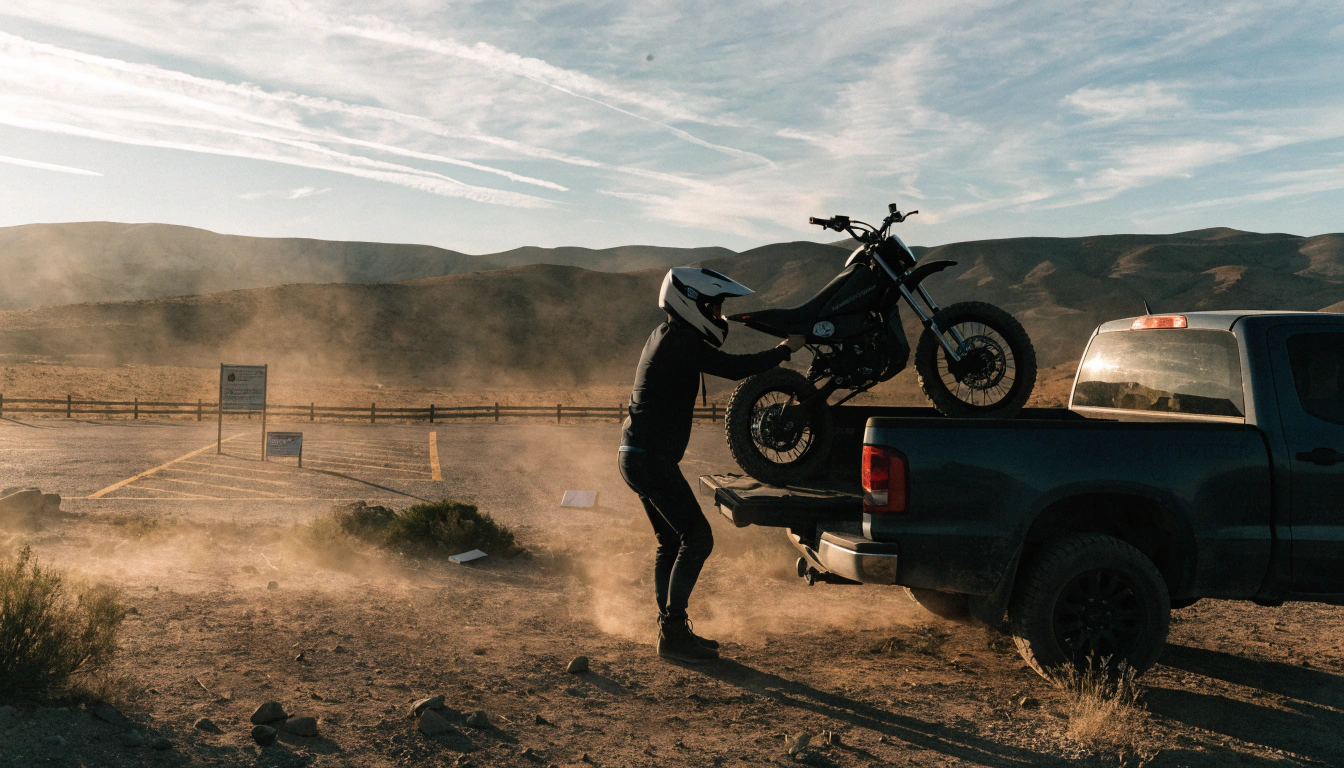
Two miles of public road between your garage and the trailhead is still two miles of public road. Load it, drive it, drop the tailgate. The truck trip isn't the boring part. It's the legal part.
Match the bike to the rider's age
Valtinsu runs a strict age ladder, and we don't bend it. The EM-5 is the only model rated under 18 — 13+. The EM-5 Pro is a performance trail motorcycle for adult riders, 18+ adults only. No exceptions, no “he's mature for his age.” Shopping for someone under 18? It's the EM-5. Full stop.
Which Valtinsu Fits Your Riding?
|
EM-5 — Ages 13+ (Trail Starter)
48V | 3,840W peak | 190 N·m | 37 mph | IPX6 | Three modes
The only Valtinsu model rated under 18. Approachable torque delivery for first-time off-road riders on private land and OHV parks.
From $1,259 USD
|
|
EM-5 Pro — Adults 18+ only (Performance Trail)
60V | 4,800W peak | 240 N·m | 43 mph | IP65 | Black or Volt Green
Geared motor torque for fire roads, singletrack, and 30°+ grades. Built for grown adults who want real trail performance without a $4,000 price tag.
From $1,699 USD
|
|
Age rule — no exceptions
EM-5 = 13+ | EM-5 Pro = 18+ adults only. Parents shopping for a rider under 18 must choose the EM-5.
|

Conclusion
A street legal dirt bike comes down to one question, and power isn't it. The question is whether the bike was built for the road — and whether your state's paperwork agrees. Dual-sports clear that bar at the factory. Off-road and electric dirt bikes don't, and a $600 lighting kit won't rewrite a title that already said no.
So make the call before you spend a dollar. Read the VIN off the frame. Ask the DMV the one thing that settles everything: was this bike manufactured for both on- and off-highway use? If the answer's no, the smarter money buys a purpose-built machine — a dual-sport for the road, or an honest off-road bike like the EM-5 for the dirt. Figure out which kind of riding you actually want first. The road, or the trail? Answer that, and the legal path picks itself.
FAQs
What makes a dirt bike street legal?
DOT lights, a mirror, a horn, road-legal tires, a speedometer, a road VIN, registration, insurance, and a Class M license. If the title reads “off-road use only,” several states won't register it no matter what you add. Call the DMV with the VIN before you spend anything.
Can a dirt bike be made street legal?
Sometimes. A gas off-road bike can often convert with a kit, DOT tires, an inspection, and a title the DMV accepts. The VIN usually decides it — if it says off-road only, a state like California won't budge. Arizona, Montana, and Colorado are the easier ones.
What is a street-legal dirt bike called?
A dual-sport motorcycle. It's factory-built for pavement and dirt, sold road-ready with the lights, mirrors, horn, and tires the law wants. The Honda CRF450RL and KTM 500 EXC-F are two common ones.
Are electric dirt bikes street legal?
Most aren't. The Forest Service and state DMVs file electric dirt bikes as off-highway vehicles, not e-bikes. The EM-5 Pro runs 60V, 4800W peak, 43 mph with no pedals — that's a motor vehicle. Without registration as a motorcycle, keep it off the road.
How much does it cost to make a dirt bike street legal?
Figure $800 to $2,000 once you add the kit, DOT tires, inspection, registration, and first-year insurance. Pay a shop and it climbs. The kit hardware alone is only $300 to $700 — the rest is fees and labor.
Can you ride a dirt bike on the road?
Only if it's registered and plated as a street-legal motorcycle in your state. A bare off-road or electric dirt bike on a road is an unregistered motor vehicle. And neighborhood streets count — the first block past your driveway is a public road.
Which dirt bikes are street legal?
Factory dual-sports: Honda XR150L and CRF450RL, Kawasaki KLX230, Yamaha XT250, KTM 350 and 500 EXC-F, Suzuki DR-Z400S. Those come road-legal from the dealer. Pure motocross bikes and most electric off-road bikes don't.
Why are some states easier for street-legal conversion?
State vehicle codes differ on whether they'll take an off-road-only VIN for road registration. Arizona, Montana, and Colorado have workable paths. California requires the bike to be built dual-use and rejects off-road-only titles, so conversion there is basically closed.
Sources
-
New York DMV, “Register a Limited Use Motorcycle (Moped).”
-
Valtinsu, “Electric Dirt Bike Collection.”
-
Valtinsu, “EM-5 Pro Electric Dirt Bike.”


Looking for something else?
Electric Dirt Bike Setup for Hardpack Trails
LEARN MORE
Electric Dirt Bike Mud Riding: Setup, Technique and Cleanup
LEARN MORE
Can You Ride an Electric Dirt Bike on Forest Service Roads?
LEARN MORE
Electric Dirt Bikes at OHV Parks: Rules and Checklist
LEARN MORELooking for something else?
Hot-Weather Electric Dirt Bike Guide: Battery, Rider and Range
LEARN MORE
How to Ride an Electric Dirt Bike Over Wet Roots
LEARN MORE
Electric Dirt Bike Ruts and Washouts: Line Choice and Recovery
LEARN MOREYou may also like
Moto eléctrica todoterreno para adultos EM-5 con luz
€1.299,00
€1.599,00
VALTINSU EM-5 Pro Off-Road Black Electric Dirt Bike
€1.699,00
€1.899,00
VALTINSU EM-5 Pro Green Electric Dirt Bike
€1.699,00
€1.899,00
Further reading
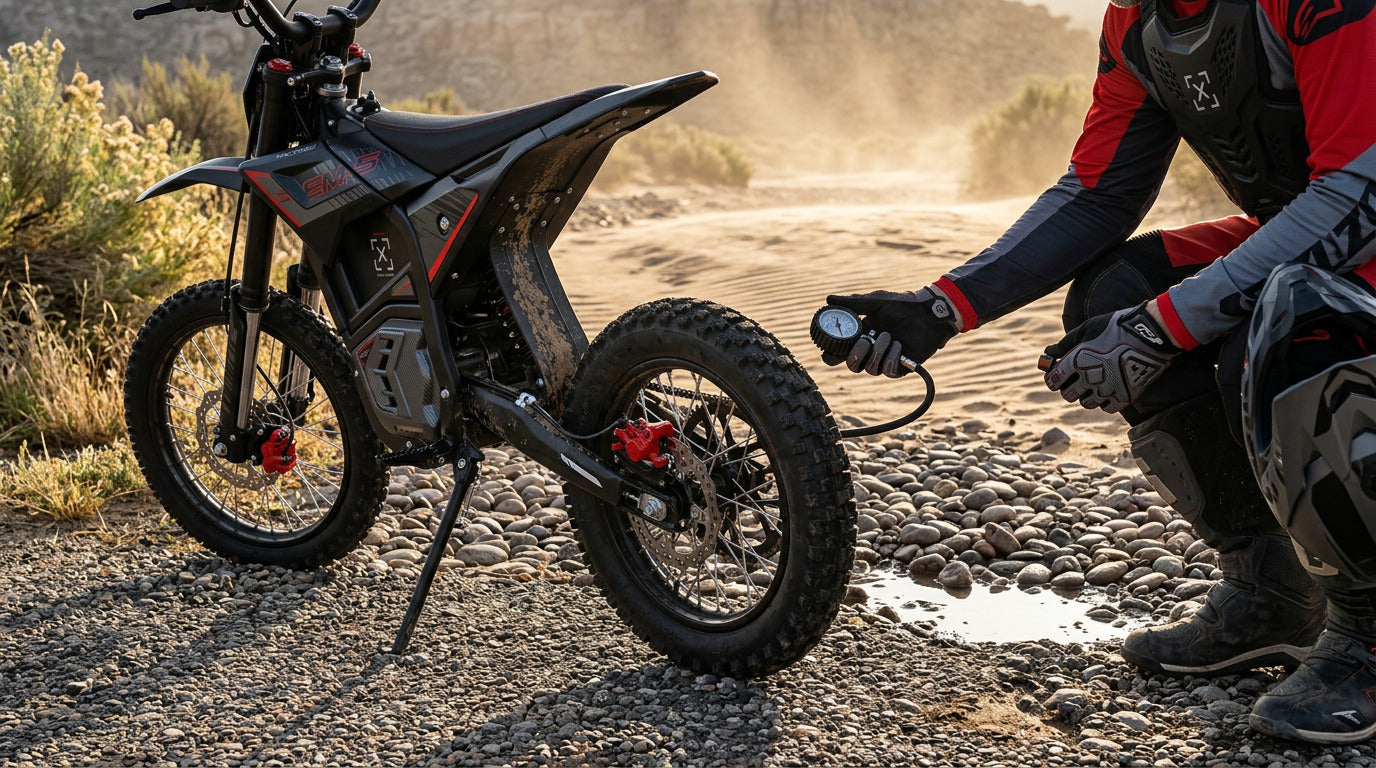
Electric Dirt Bike Tire Pressure by Terrain: PSI Starting Points
Electric dirt bike tire pressure should start with the exact tire and motorcycle limits, then change with terrain, rider load, tire construction and impact risk. Softer ground usually favors a lowe...
Electric Dirt Bike Suspension Sag Setup: A Rider-Weight Method
Electric dirt bike suspension sag setup starts by measuring the rear suspension fully extended, then measuring it again with the bike alone and with you in full riding gear. Use those readings to e...
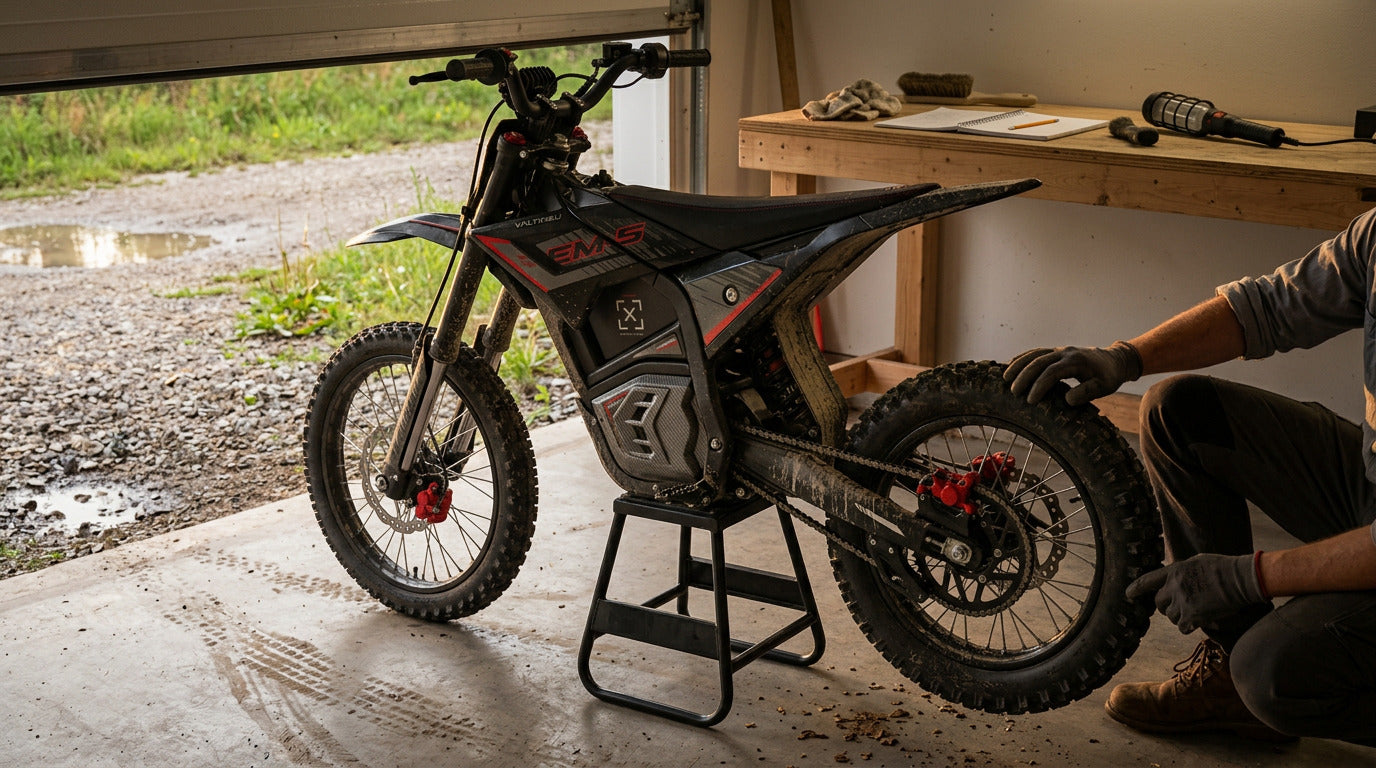
Your First 100 Miles on an Electric Dirt Bike: Break-In and Service Checklist
The first 100 miles on an electric dirt bike are an inspection period rather than a gas-engine-style mechanical break-in. Check the motorcycle at 0, 25, 50 and 100 miles for hardware settling, chai...
Electric Dirt Bike Ground Clearance vs Suspension Travel: What Each Number Means
Electric dirt bike ground clearance is the vertical space between the ground and the motorcycle’s lowest relevant chassis point, while suspension travel is how far the wheel and suspension can move...