

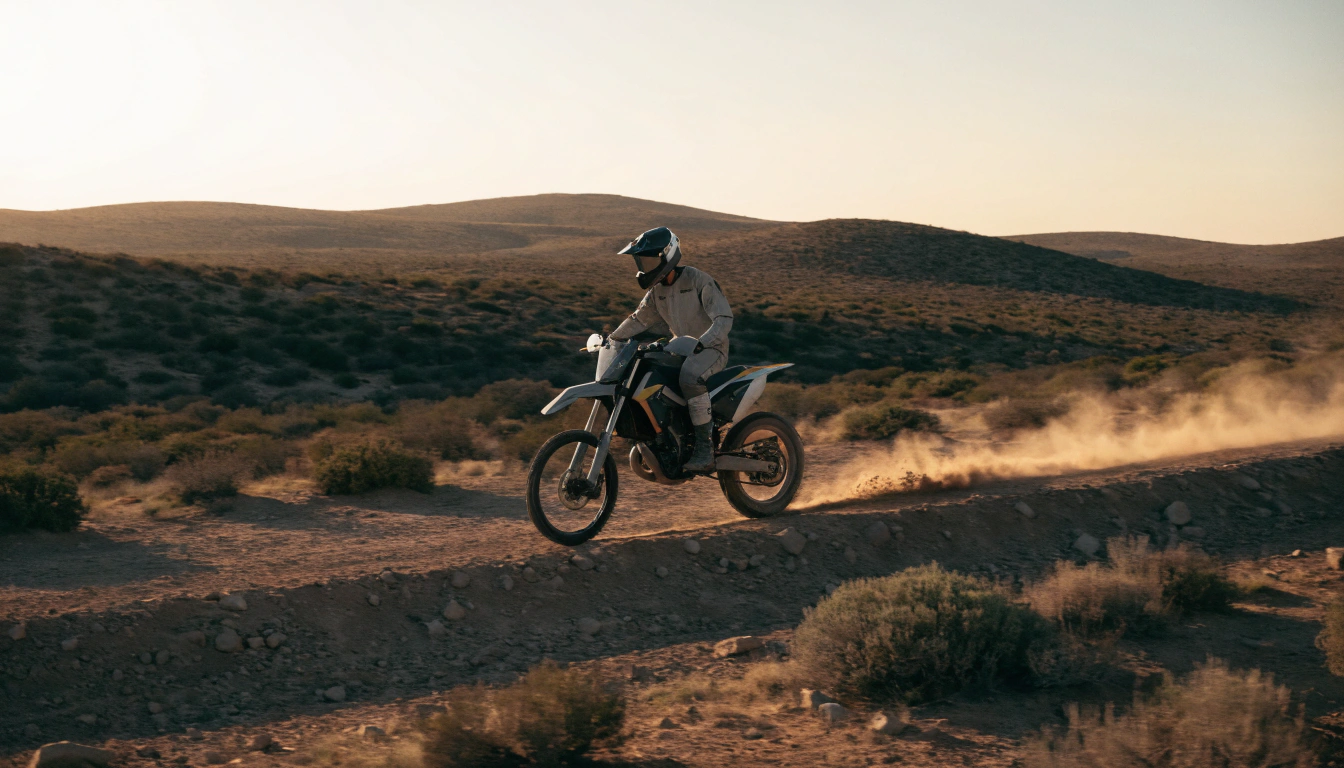
How Fast Is 72V 2000W in MPH? Speed, Torque & Range
Derek texted me a spec sheet at 11 at night. Four tabs open. A 72V 2000W build, and a seller swearing up and down it hit 60 mph. His question was one line: “is that real, or am I getting sold a number?”
Mostly the number. Look, a 72V 2000W motor is genuinely quick for an electric bike, scooter, or light off-road build. Nobody’s arguing that. But the honest answer to how fast 72V 2000W goes in mph? Thirty to forty-five on flat ground. That’s the real band. Sure, some setups flash 50 for a second or two. Holding it is a whole other conversation.
And here’s the part the marketing pages skip right past. Top speed isn’t the motor’s decision alone. It’s the whole system voting on it. Voltage. Controller amps. Your weight. Tires. Wind. Whatever you’re climbing. Nudge any one of those and the final number slides. Which is exactly why an adult electric off-road bike built for real terrain rides nothing like the commuter e-bike parked next to it — even when the spec sheets read the same wattage.
|
Quick answer
A 72V 2000W motor realistically runs 30-45 mph on flat pavement. Light rider, full pack, a controller that isn’t choked? You might see ~50 for a moment. Heavier rider, a hill, a headwind, or a weak controller drags it into the low 30s. Plan around 35-40 and you won’t be disappointed.
|
How Fast a 72V 2000W Motor Really Goes

Real-world riding puts most 72V 2000W electric bikes and light builds somewhere in the 30-45 mph range. Lighter rider, flat pavement, full charge, a controller doing its job — you’ll see the top of that band. Heavier rider, soft tires, riding into a headwind — you’ll see the bottom. Both are true. Neither one is the bike lying to you.
So where do the 50-60 mph claims come from? Two places, usually. Either a best-case dyno run with a 130-pound rider and zero wind, or a no-load motor test — the wheel spinning free in the air with no bike attached, no rider, no road. Great for a product photo. Worthless for planning a Saturday ride.
|
Configuration
|
Top Speed (mph)
|
When You See It
|
|
Standard setup, average rider
|
30-38 mph
|
Most real-world riding
|
|
Light rider, flat, full battery
|
40-45 mph
|
Good conditions, strong controller
|
|
Best-case / short burst
|
~50 mph
|
Briefly, then it falls off
|
|
Heavier rider, hills, wind
|
28-34 mph
|
Loaded or climbing
|
Let me say the quiet part out loud: a flat 60 mph claim on a 2000W system should make you suspicious. Here’s why. Air resistance doesn’t rise in a straight line — it climbs fast, and the power needed to push through it climbs faster still. So the last 5 mph cost more than the first 30. That’s not me being a downer. That’s the same efficiency curve the U.S. Department of Energy lays out for any electric drivetrain. Physics doesn’t care what the listing says.
Peak Speed vs Sustainable Speed
Peak is the number the bike touches for a heartbeat. Sustainable is what it’ll hold all day without cooking the motor, draining the pack in twenty minutes, or pushing the controller past where it wants to live. A 72V 2000W setup might flash 48 mph dropping down a hill with the wind behind you. Cruising the flats for an hour straight? Closer to 28-35. That gap right there — that’s the whole reason people feel cheated by top-speed claims. The number was real. It just wasn’t the number they’d actually live with.
|
Speed Type
|
What It Is
|
What You Plan Around
|
|
Peak / burst
|
A few seconds, best conditions
|
Bragging, not commuting
|
|
Sustained
|
Held for minutes without heat issues
|
Your real daily speed
|
|
The gap
|
Often 10-15 mph between the two
|
Bigger on weaker controllers
|
What 72V and 2000W Actually Mean

The 72V is your battery system voltage. The 2000W is the motor’s power level. Put them together and you’ve got a rough speed estimate. Rough. Not a verdict. A 2000W 72V motor can feel like two completely different machines depending on the controller wired to it, the gearing behind it, the tires under it, and how much weight it’s dragging around.
Want the deep version of how to read motor numbers before you spend a dime? The watts and torque guide for electric dirt bikes goes through peak versus continuous properly. The short version for right now: voltage gives the motor a taller base to push from, which helps both acceleration and top-end. And a full 72V pack just feels stronger than the same pack sitting at 40 percent — because as the voltage sags, your speed sags right along with it. Nothing you can do about that except charge up.
Why Controller Amps Decide So Much
The controller is the bouncer between your battery and your motor. It decides how much current actually gets through to the windings. Bolt a 2000W motor to a choked 30A controller and the thing feels half-asleep. Wire that same motor to a clean 50-60A controller and it wakes up — alert off the line, holds speed under load. This is the number-one reason a bike’s advertised top speed never shows up on your street. The motor could do it. The controller just won’t let it. So ask the amperage before you buy. If the seller can’t tell you? That’s your answer right there.
Speed, Torque, and Why Acceleration Feels Faster

Speed is how fast you’re moving. Torque is the twisting force that launches you off the line, drags you up the hill, and hauls you out of soft sand before you bog down and tip over. A 72V 2000W build can feel downright strong even when its top speed isn’t anything wild — because an electric motor hands you torque the instant you ask for it. From zero RPM. No clutch dance. No hunting for gear. You crack the throttle and the bike just leaves.
That instant shove is exactly why a bike can feel like a rocket from 0 to 25 and then suddenly turn into molasses crawling toward 45. The first half of the throttle is torque doing the work. Top end is a slugfest with the air. And for trail riding, for actual off-road? The torque half is the half you live in. Top speed is a party trick you use for four seconds out of a two-hour ride.
Hub Motors vs Geared Motors
A direct-drive hub motor sits inside the wheel and smears its power evenly across the rev range. Good for a steady flat top-end. Lazy off the line. A geared motor runs internal reduction gearing that stacks the torque down low — right where a climb or a tight switchback is begging for it. Same wattage printed on the box. Totally different animal on dirt. People forget this and then wonder why two “4000W” bikes feel nothing alike.
|
Architecture
|
Strength
|
Trade-off
|
|
Direct-drive hub
|
Consistent power across the range, higher top-end, fewer moving parts
|
Weaker from a stop, heavier, less beginner-friendly
|
|
Geared (reduction)
|
Strong low-RPM torque, climbs without bogging, trail-friendly
|
Slightly more mechanical complexity, occasional gearbox service
|
This is where Valtinsu’s lineup quietly proves the point. The EM-5 Pro runs a 60V geared brushless motor — the EM-5 Pro's geared motor puts 240 N·m of torque down at the bottom instead of chasing a flashier top-speed figure. On a 30° fire-road climb, that torque shows up the second you twist — no waiting for revs to stack up. A higher-wattage direct-drive bike, with all its bigger poster numbers, can’t always promise you that. Numbers on a page and force at the wheel aren’t the same thing.
|
Valtinsu EM-5 Pro — Adult Electric Off-Road Motorcycle (18+)
60V geared motor | 4,800W peak | 240 N·m torque | 43 mph | IPX6 | Three ride modes
Heavy-duty steel frame. 150mm hydraulic front fork, rear adjustable air shock. Hydraulic disc brakes front and rear. Removable 60V 27Ah lithium battery. CE / UL / GCC certified. Built for fire roads, singletrack, and 30° climbs — off-road use only, not street legal.
Adults 18+ only. Black or Volt Green.
From $1,699 USD | Free U.S. shipping
|
What Changes the Number on Your Ride

A 72V 2000W motor doesn’t have one speed. It has a mood. Cool flat morning, full pack? It flies. Windy uphill afternoon on a half-charged battery? It sulks. Here’s what actually moves the needle, roughly in the order you’ll feel each one.
-
Rider weight and cargo. More mass means lower top speed, slower launches, shorter range. A 150-pounder and a 250-pounder on the identical bike are not having the same ride. Simple as that.
-
Terrain and surface. Flat pavement is the friendly number. Gravel, sand, mud — they all fight you. A long climb can yank a 42 mph flat-ground bike clear down into the 20s and you’ll feel every bit of it.
-
Battery charge and health. A full, healthy 72V pack holds its voltage when the motor pulls hard. An old pack, or a cold one, sags under load — the bike feels gutless and tops out low. Charge matters more than people think.
-
Wind. Past roughly 30 mph, air is the main thing slowing you down. A headwind quietly steals several mph. A tailwind makes the same bike feel like a hero. Same machine, different day.
-
Tire size and pressure. Bigger wheels roll farther per turn but ask more torque to get rolling. And low pressure? Feels sluggish and drinks the battery. Check it before you blame the motor.
|
Total Weight (lbs)
|
Estimated Top Speed (mph)
|
Notes
|
|
~150
|
up to ~45
|
Light rider, flat, full charge
|
|
~200
|
up to ~40
|
Average adult rider
|
|
~250
|
up to ~35
|
Heavier rider or rider + gear
|
|
Field note from Maya, a controller tech in Phoenix: “People blame the motor when the bike feels slow on a hot day. Nine times out of ten it’s the controller pulling current back for heat, or the pack sagging. The 2000W is still there. The system just won’t hand it all to you when things get warm.”
|
||
How Far a 72V 2000W Motor Goes on One Charge

Range comes down to two things: how big your pack is, and how hard you twist. Bigger amp-hours, more stored energy — that part’s obvious. The part people underestimate is speed. Speed is the single biggest range killer there is. Cruising at 40 burns through the pack way faster than cruising at 22, because fighting the air at speed costs power that ramps up steeply with every extra mph. You don’t pay a little more for going faster. You pay a lot more.
|
Battery
|
Energy
|
Est. Range
|
Best For
|
|
72V 20Ah
|
~1,440 Wh
|
35-50 mi
|
Daily commuting
|
|
72V 32Ah
|
~2,300 Wh
|
55-70 mi
|
Commuting + short trips
|
|
72V 40Ah
|
~2,880 Wh
|
65-85 mi
|
Long-distance riding
|
|
72V 50Ah
|
~3,600 Wh
|
80-110 mi
|
Max range / off-road
|
Treat those as planning numbers, not guarantees. Hard off-road riding, hills, a heavier rider, full-throttle launches off every stop — all of it eats into the chart. Your real range comes from your route, not somebody’s table. Smooth throttle and a lower ride mode stretch the pack a long way. Repeated hole-shots torch it. You’ll learn your own number after a few rides anyway.
72V 2000W vs 2500W vs 3000W (and 48V 1000W)

A 72V 2000W system sits up in the high-power zone for electric bikes — well past a commuter setup, knocking on the door of light electric dirt bike or moped territory. But more watts don’t automatically buy you a better ride. They buy you a bigger number to manage. What’s actually right for you depends on your weight, your terrain, your skill, and the law where you ride. To line the off-road models up against each other, the full electric dirt bike lineup puts power, torque, top speed, and battery side by side so you’re not guessing.
|
Setup
|
Typical Top Speed
|
Strength vs 2000W
|
Watch For
|
|
48V 1000W
|
20-28 mph
|
Calmer, lighter, easier to keep legal
|
Underpowered for hills / heavy riders
|
|
72V 2000W
|
30-45 mph
|
Strong all-round trail/commute power
|
Already past most e-bike laws
|
|
72V 2500W
|
35-50 mph
|
More pull, slight top-end gain
|
Needs matching controller + pack
|
|
72V 3000W
|
40-55 mph
|
Near electric-motorcycle territory
|
More heat, more stress on brakes/tires
|
Here’s the trap. The jump from 2000W to 2500W buys you stronger acceleration and better hill pull — not much top speed, because air resistance eats most of that gain above 35 mph anyway. And going to 3000W gets you closer to electric-motorcycle shove, sure, but it also raises the stakes on brakes, tires, frame, and your own skill. Bigger isn’t automatically better. For a whole lot of riders, 2000W was already more than they’d ever use.
Is a 72V 2000W Bike Even Legal on the Road?

Short version: usually not — at least not as a regular street e-bike. The Bureau of Land Management and most state codes draw the line at a legal e-bike being a bicycle with a motor of 750W or less and working pedals. A 72V 2000W machine is roughly 2.7 times that power, and most builds have no pedals at all. So it falls into moped, motorcycle, or off-highway-vehicle territory depending on which state you’re standing in.
And the quiet motor? Changes nothing. Ride an unregistered 2000W build on a public road and you’re looking at fines, possible impoundment, and — the one that really stings — a denied insurance claim if you go down. Before you ride anywhere public, call your state DMV. The electric dirt bike street legal rules guide breaks down what actually counts as road-legal and where you can ride without inviting the paperwork headache in the first place.
|
How to tell if it's not a legal e-bike
Start with power and throttle. A 2000W motor running 35-45 mph on throttle alone basically never fits standard e-bike rules. Then look for the hardware that defines classification — pedals, a VIN, lights, mirrors, a speedometer. Missing those changes the category. Then ask the real question: where are you riding it? Private land is one rulebook. Public roads and shared trails are a completely different one.
|
Safety Before You Chase the Top Number

At 35-50 mph, weak brakes and bald tires stop being a minor gripe and start being a hospital visit. A 2000W build needs stopping power that matches its speed — hydraulic discs front and rear, not the mechanical pads that came on something built for toy-grade speeds. Tires actually rated for your load and your terrain. A frame that won’t flex like a noodle under a heavy pack and a motor that pulls hard. And gear. A bicycle lid is not enough at moped speeds, full stop. The NHTSA sets the DOT helmet standard, and it’s the bar worth clearing.
Speed also steals your reaction time. The faster you go, the less margin you’ve got when something goes sideways. So if you’re new to this, start in a lower ride mode. Learn the brakes in an empty parking lot before you trust them on a trail. Build up. Speed is the fun part, no argument. But control is the part that gets you home. A slower ride you can actually manage beats a fast one you can’t, every single time.
The Honest Bottom Line
Derek never bought the 60 mph build. He GPS-tested his own setup instead and clocked 41 on flat ground, 33 on his usual hilly loop. Right where the math said he’d land. No drama. He stopped chasing the seller’s fantasy number and just… went riding. Which was the point all along.
So, how fast is 72V 2000W in mph? Call it 30-45 in the real world. The top of that band belongs to light riders, flat ground, a healthy pack, and a controller that isn’t strangling the motor. Read the number in context — voltage, amps, weight, tires, terrain. Read it alone, off a listing, and you’ll end up with the wrong machine. Too much top end and no climb. Or all climb and no legs. Either way, buyer’s remorse.
And for trail and off-road, torque outworks top speed nearly every time. A geared motor that yanks hard from a dead stop will feel more capable than a higher-wattage bike with a lazy bottom end — you’ll feel it the second you crack the throttle on a climb. The real question was never “how fast.” It was “fast enough for what, and built well enough around the motor that I can actually use the thing safely?” Answer that and the right bike basically picks itself.
Here’s the whole thing in four lines, if you skim:
-
Plan for 30-45 mph. Not the listing’s 60. GPS-test your own setup if it matters to you.
-
Ask the controller amperage. It decides whether the motor’s rated power ever shows up.
-
Chase torque for dirt, not top speed. A geared motor low in the rev range beats a bigger poster number.
-
Know the law before the road. A 2000W build is almost never a street-legal e-bike. Off-road or registered, pick one.
|
Which Valtinsu Matches the Power You Need
Real specs. Real age ratings. No fabricated top-speed claims.
EM-5 Pro (18+ adults only): 60V · 4,800W peak · 240 N·m · 43 mph · geared motor for fire roads, singletrack, and 30° grades. Black or Volt Green. From $1,699.
EM-5 (13+, supervision under 16): 48V · 3,840W peak · 190 N·m · 37 mph · the only youth-rated bike in the lineup. From $1,259.
|
|
Age rule — no exceptions
EM-5 Pro is rated 18+ adults only. EM-5 is rated 13+ (riders under 16 need adult supervision). The Pro models aren't an option for minors, no matter how a forum thread frames it. Parents shopping for a rider under 18 choose the EM-5.
|
|
Stay in the know. Get Valtinsu’s adult electric off-road buyer guides — spec breakdowns, terrain guides, and honest comparisons — straight to your inbox. No countdowns, no hype.
|
FAQs
How fast will a 72V 2000W go?
Usually 30-45 mph in real riding. A light rider on flat pavement with a full battery and a controller that isn’t choked might brush ~50 for a second, but that’s not what you’ll live with day to day. Your weight, your charge level, controller amps, wheel size, wind — they all push the number around. Plan for 35-40 unless you’ve GPS-tested your exact build.
How fast is 2000W in mph?
A 2000W electric bike or scooter usually runs 28-45 mph, depending on voltage and how it’s built. On a 72V system, expect the higher end of that. Wattage alone doesn’t settle it, though — a 2000W motor on 48V feels different from the same motor on 72V, and a heavy moped frame asks more of the motor than a light bicycle. Check voltage, controller amps, and a tested speed before you trust any seller’s claim.
How fast is 72V 2500W in mph?
Roughly 35-50 mph in real riding. That extra 500W over 2000W shows up as stronger acceleration and better hill pull more than top speed — air resistance eats most of the high-end gain above 35 mph anyway. And the controller and battery have to actually support the added current, or the bump is tiny. Pick 2500W for the pull, not the bigger number on the box.
How fast will 72V 3000W go?
Often 40-55 mph when the whole system’s built for it — controller, pack, motor type, wheel size, weight, all of it. Next to 2000W, a 3000W setup launches harder and climbs better. It also runs hotter and leans harder on your brakes and tires. At this power you’ve basically left normal e-bike rules behind and wandered into moped or electric-motorcycle territory.
Is 48V 1000W legal?
Often not, at least not as a standard street e-bike. Most e-bike rules cap motor power around 750W with working pedals, so 1000W can step right over that line. Where you ride decides the rest — some places allow more power on private land or off-road areas while keeping public roads and shared trails strict. Check your state DMV or the trail authority before you ride it anywhere public.
How to tell if an ebike is illegal?
Start with motor wattage, throttle-only top speed, and where you’re riding. A 2000W motor doing 35-45 mph usually falls outside standard street e-bike rules. Then check the hardware — pedals, lights, mirrors, a VIN, registration, insurance — because classification hangs on it. Public roads, bike lanes, and off-road trails each have their own rulebook. And don’t lean on a seller’s “street legal” sticker; that’s marketing, not law.
Can a Surron go 70 mph?
Some modified Surron builds get there, but that’s not the stock answer. Out of the box, top speed depends on the model, the controller limits, and the ride mode. Riders hitting 70 have usually added a stronger controller, a higher-output battery, or motor tuning — changes that pile on heat, cut range, and open up safety and legal headaches. At that point it rides like an electric motorcycle, not an e-bike, and the law tends to agree.
How far can a 72V 2000W go on one charge?
Roughly 35-50 miles on a 72V 20Ah pack, or 55-70 on a 32Ah pack, in mixed riding. Speed is the wildcard — cruising at 40 drains it way faster than 22. Hills, a heavier rider, and full-throttle launches all chip away at it too. Treat the chart as a planning range and pack a buffer for your actual route. You’ll dial in your own real number after a ride or two.
|
A note on the topic: speed limits, motor-power caps, and e-bike classification vary by state and change over time. Always confirm current local rules with your DMV or land manager before riding a high-power build in any public area.
|
Sources
-
Bureau of Land Management — E-Bikes on BLM-Managed Public Lands (legal e-bike definition: ≤750W with pedals).
-
U.S. Department of Energy — Electric Vehicles and Chargers: motor and battery efficiency primer.
-
USDA Forest Service — Motor Vehicle Use Maps (MVUM) for designated off-road riding.
-
Valtinsu — Electric Dirt Bike Collection.
-
Valtinsu — Watts and Torque Electric Dirt Bike Guide


Looking for something else?
Electric Dirt Bike Setup for Hardpack Trails
LEARN MORE
Electric Dirt Bike Mud Riding: Setup, Technique and Cleanup
LEARN MORE
Can You Ride an Electric Dirt Bike on Forest Service Roads?
LEARN MORE
Electric Dirt Bikes at OHV Parks: Rules and Checklist
LEARN MORELooking for something else?
Hot-Weather Electric Dirt Bike Guide: Battery, Rider and Range
LEARN MORE
How to Ride an Electric Dirt Bike Over Wet Roots
LEARN MORE
Electric Dirt Bike Ruts and Washouts: Line Choice and Recovery
LEARN MOREYou may also like
Moto eléctrica todoterreno para adultos EM-5 con luz
€1.299,00
€1.599,00
VALTINSU EM-5 Pro Off-Road Black Electric Dirt Bike
€1.699,00
€1.899,00
VALTINSU EM-5 Pro Green Electric Dirt Bike
€1.699,00
€1.899,00
Further reading
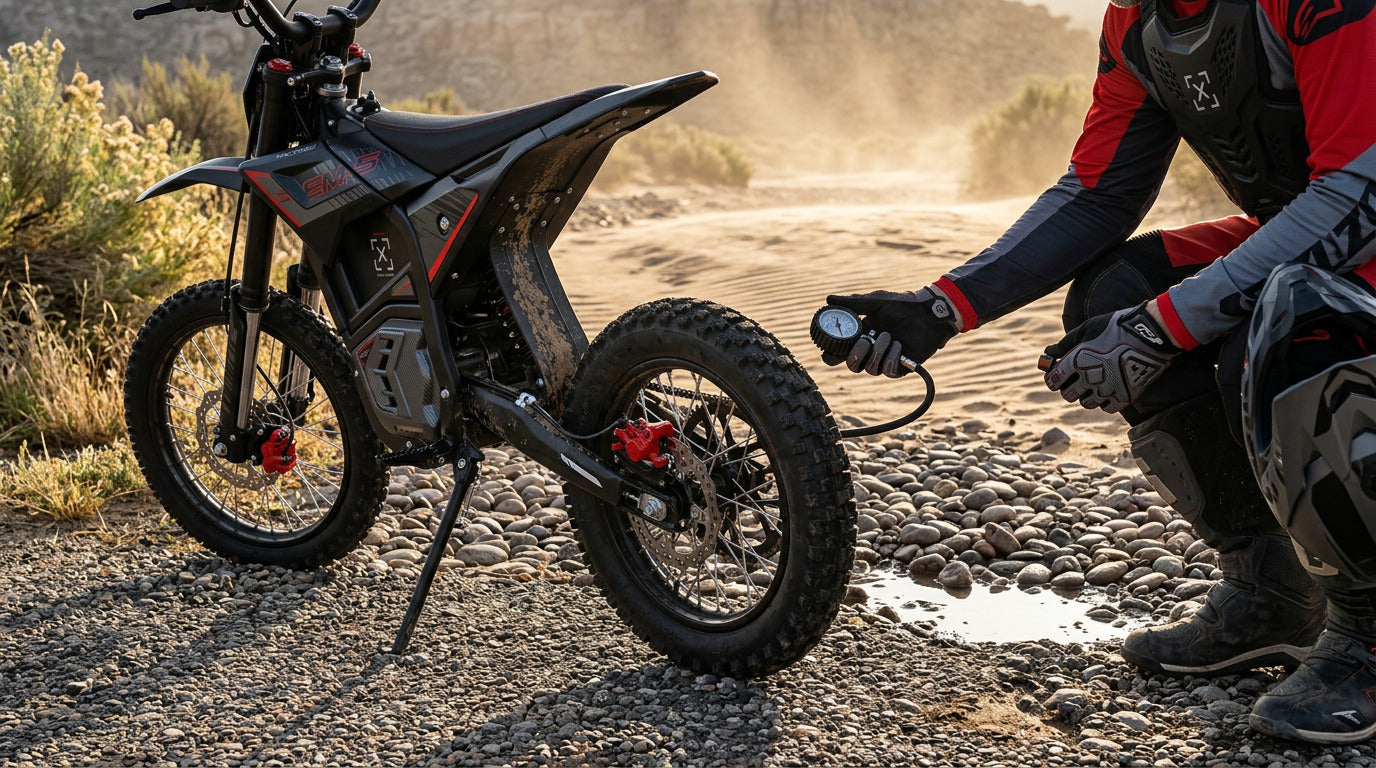
Electric Dirt Bike Tire Pressure by Terrain: PSI Starting Points
Electric dirt bike tire pressure should start with the exact tire and motorcycle limits, then change with terrain, rider load, tire construction and impact risk. Softer ground usually favors a lowe...
Electric Dirt Bike Suspension Sag Setup: A Rider-Weight Method
Electric dirt bike suspension sag setup starts by measuring the rear suspension fully extended, then measuring it again with the bike alone and with you in full riding gear. Use those readings to e...
Your First 100 Miles on an Electric Dirt Bike: Break-In and Service Checklist
The first 100 miles on an electric dirt bike are an inspection period rather than a gas-engine-style mechanical break-in. Check the motorcycle at 0, 25, 50 and 100 miles for hardware settling, chai...
Electric Dirt Bike Ground Clearance vs Suspension Travel: What Each Number Means
Electric dirt bike ground clearance is the vertical space between the ground and the motorcycle’s lowest relevant chassis point, while suspension travel is how far the wheel and suspension can move...