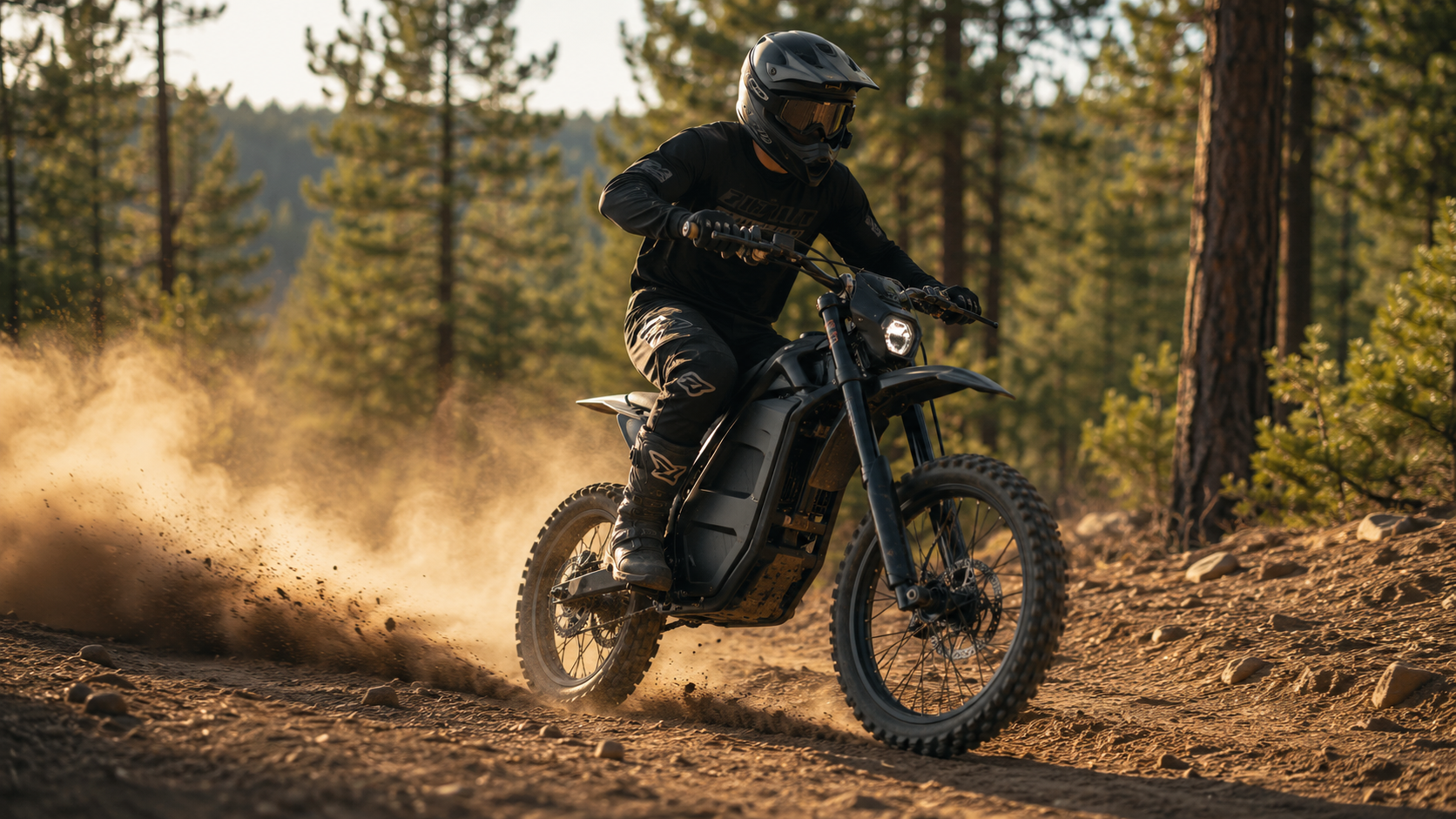
Electric Dirt Bike With Pedals vs No Pedals: What’s Legal and Practical
Pedals decide the law. Add functioning pedals and keep the motor under 750W with a 20 to 28 mph cap, and most states read the machine as a bicycle. Strip the pedals, fit foot pegs and a twist throttle, and it becomes an adult electric off-road motorcycle, an off-highway vehicle in the eyes of the law. Same two wheels. Completely different rulebook. This guide covers what changes, where each one can ride, and how to pick the right side of that line.
The short version, before the detail:
|
|
Pedal electric dirt bike
|
No-pedal (throttle-only)
|
|
Drives like
|
A bicycle with a strong push
|
A small electric motorcycle
|
|
Legal class (US)
|
Often Class 1/2/3 e-bike
|
Off-Highway Vehicle / motorcycle
|
|
Power / speed
|
≤750W, 20–28 mph to stay a bike
|
No cap; often 3,840W to 7,000W
|
|
Where it rides
|
Bike lanes, many trails, roads
|
Private land, OHV parks, dirt only
|
|
Backup if battery dies
|
Pedal home
|
Push it
|
Pedals buy you access. No pedals buy you power. Most of the confusion comes from machines built to blur that line on purpose, which is where people get tickets.
Understanding the Real Difference
Two bikes can look almost identical in a parking lot and sit in different legal universes. The split is not the frame or the tires. It is whether a human can still put power to the ground.
A pedal model keeps the bicycle DNA. Sensors read your pedaling, the electric motor adds to it, and you can limp home on leg power alone. A throttle-only model hands everything to the motor. Twist, go. There is no pedaling, only foot pegs, and that one design choice is what reclassifies the whole machine in most regions.

Pedal-Assist Electric Dirt Bikes, Explained
Pedal assist works off a sensor. As you pedal, a cadence or torque sensor tells the controller how much help to add, and the motor scales power to match. Human effort still matters. The ride builds gradually instead of snapping forward, which is why low-speed control feels smoother.
Most of these run a 750W motor or smaller to stay inside e-bike rules. You shift between light pedaling and motor support as the trail demands. On a long ride you can back off the assist to stretch the battery, a trick no throttle-only bike offers.
Throttle-Only Electric Dirt Bikes, Explained
No pedals here. A twist or thumb throttle controls speed, the motor does all the work, and the bike moves with zero input from your legs. The payoff is instant torque and a much higher ceiling, the EM-5 at 3,840W, the EM-5 Pro at 5,600W, the EM-5 Ultra at 7,000W. Numbers a pedal bike never reaches.

The feel is closer to a lightweight electric motorcycle than a bicycle. Acceleration is immediate, climbing is stronger, and the trade is legal access. Past the 750W and 28 mph lines, you have left bicycle territory for good.
Why the Two Get Mixed Up
Marketing, mostly. Some high-power machines bolt on pedals purely to qualify for bike-path access, even when the pedals are near-useless above walking speed. Others drop pedals entirely and lean into the performance story. Riders then assume pedals alone decide classification.
They don’t. Pedals are one input. Motor wattage and top speed carry just as much weight, and in a lot of states they carry more. A bike with pedals can still be an illegal motor vehicle on a bike path if it makes too much power.
How They Work in Real Riding Conditions
Spec sheets only tell half of it. The gap shows up the moment terrain, rider input and throttle response meet actual dirt.
Riding With Pedals and Motor Support
It feels like cycling with a tailwind that never quits. The motor answers as you pedal, hills flatten out, and effort splits between you and the battery. On tight or mixed terrain that gradual delivery keeps the bike planted and predictable.
Want more range? Pedal more, draw less. It is the less aggressive option, and for a lot of casual riders that balance is the appeal.
Full Throttle on a No-Pedal Bike
Throttle riding is reactive. Power arrives the instant you twist, with no pedal stroke to wait on, so clearing a root or a loose climb happens fast. That immediacy is the point of an adult electric off-road motorcycle.
It also asks more of you. Instant torque punishes a lazy throttle hand, and the experience sits much closer to motocross than to a bike path cruise. In our experience guiding first-time buyers, this is the single biggest adjustment riders coming off a bicycle have to make.
How Power Delivery Changes Control
Gradual or instant, that is the whole story. Pedal assist spreads power, which steadies things at low speed and tires you out slower over a long day. Throttle systems deliver full torque now, which means more response and a steeper learning curve.
Beginners usually find smooth delivery easier to read. High-torque throttle setups reward experience. Neither is better in a vacuum. They suit different riders.
Legal Rules That Actually Matter
Classification almost never hangs on a single feature. Several technical limits decide it together, and they vary by where you stand.
For the deeper breakdown of how a bicycle and an electric off-road machine diverge in law, our guide to the street legal ebike vs dirt bike rules walks through it state by state.
When Pedals Help a Bike Fit E-Bike Rules
In many states, working pedals plus a motor inside the limits put a machine in the electric-bicycle class. Pedal-assist systems read as close cousins of a regular bike, which is the whole legal advantage.
Pedals alone are not a free pass. Authorities weigh the full system, and a model over the power or speed cap can lose bicycle status no matter how many pedals it has.
When No-Pedal Bikes Fall Into Off-Road Categories
Throttle-only machines usually land as Off-Highway Vehicles. No human input, full motor drive, and that pushes them clean out of bicycle rules. The upside is clarity: you know exactly where you stand.
The downside is access. These are typically barred from bike lanes and public cycling paths, and live on private property or designated OHV areas instead. Every Valtinsu sits here, off-road use only, not street legal.
Speed, Wattage and Throttle: The Real Triggers
Three things move a machine across the line. Motor wattage first: the federal definition caps an e-bike at 750W, and the three-class framework PeopleForBikes created (now adopted in 40-plus states) hangs off it. Top speed second, with 20 mph and 28 mph as the usual class breaks. Throttle capability third, since a hand throttle alone gets a model restricted in many places.
-
Wattage. Over 750W and most states stop calling it a bicycle.
-
Speed caps decide the class: 20 mph for Class 1/2, 28 mph for Class 3.
-
A throttle with no pedal requirement is the fastest way to lose bike-path access.
Why the Same Bike Is Legal in One Place, Not Another
Laws shift across state lines and even between cities. One county allows throttle use, the next bans it outright, and speed caps differ on top of that. California, for one, defines its three e-bike classes in Vehicle Code 312.5, capping a legal e-bike at 750W with operable pedals; other states word it differently.
Manufacturers build for a global market, not one statute, so identical models carry mixed legality. Check your local rule before you ride. Every time.
Where You Can Ride Each Type
Where matters as much as what. Legal class maps directly to road, trail and private-land access.

Cities and Bike Lanes
Pedal models that meet local e-bike rules can often use bike lanes, inside the usual speed and power caps. Throttle-only bikes generally cannot. Urban enforcement tends to be stricter, so commuting realistically belongs to the pedal side.
Trails and Mixed Terrain
Some trails admit pedal-assist e-bikes under set conditions. No-pedal bikes are usually off-limits unless the trail is signed for motorized use. Park and land-manager policy decides it, and it changes by location.
Private Land and OHV Parks
This is home turf for throttle bikes. On private land you run full power with no public restriction, and a designated OHV park is built for exactly this kind of machine. It is where an adult electric off-road motorcycle does its best work.
Performance Differences on the Trail
Under real pressure the two diverge hard. Speed demand, terrain and control style separate them.

Range in Real Riding
Pedal assist saves battery; throttle-only burns it faster under constant load. Terrain swings both. Steep, rough ground spikes the draw on either system, and across the Valtinsu lineup that lands at roughly 50 to 75 miles a charge depending on model and how hard you ride.
Suspension, Control and Stability
No-pedal bikes tend to carry stronger suspension because they move faster and hit harder. Hydraulic front shocks, rear air on the EM-5 Pro and Ultra, IPX6 sealing on the off-road models. Pedal bikes lean toward comfort and efficiency. Higher speed simply needs more travel to stay composed.
Learning Curve and Confidence
Pedal-assist bikes feel familiar to anyone who has ridden a bicycle. Throttle systems take adjustment before the control gets smooth. Confidence builds quicker on predictable power, which is the case for starting gentle and dialing up.
Choosing the Right Setup
It comes down to where you ride most and what you are legally allowed to do there.
When Pedal-Assist Makes More Sense
Mixed legal environments, road-plus-light-trail use, and longer range needs all point to pedals. They suit commuters and casual riders who want some exercise with their motor support. Access is the headline advantage.
When No-Pedal Is the Better Fit
Off-road performance riders want throttle. Stronger acceleration, higher torque, built for controlled spaces. Not for public commuting, and legal limits keep it off shared paths, but on dirt the performance is the whole point. A throttle-only machine like the EM-5 Pro is built around that ceiling, 52 mph from a 5,600W motor for $1,699.
Riders Who Want Both
Plenty of people keep a pedal bike for the commute and a no-pedal machine for the weekend. Two tools, two jobs. Budget and how often you ride each one usually settle the question.
If You’re Choosing a No-Pedal Valtinsu
Match the bike to the rider, not the spec sheet. The quick map, with the full range on the full Valtinsu electric dirt bike lineup page:
-
New or younger rider: the EM-5 with light — 40 mph, lower seat, rated 13+, the only model for under-16s.
-
Most adults: the EM-5 Pro — 52 mph, 59-mile range, 18+. The all-rounder.
-
Open ground and big wheels: the EM23 — highest torque in the line, a 4-second sprint, 16+.
-
Most headroom: the EM-5 Ultra — 72V, 7,000W, 56 mph, reverse gear, 18+.

Cost and Long-Term Ownership
The sticker is the start, not the total. Maintenance, battery care and durability decide real value.
Up-Front Price
Pedal models swing widely on features. No-pedal bikes often cost more because the components are heavier-duty, and motor size drives most of that. Both categories have entry options; price usually tracks intended use.
Maintenance Over Time
Pedal systems stress parts less. Throttle systems load brakes and suspension harder, so service comes around sooner, and high-speed riding speeds up wear. Pre-ride checks matter either way. Replacement brakes, throttles and controllers are stocked on the accessories page.
Battery Life and Replacement
Battery life follows riding style and terrain. Throttle-heavy use drains faster; pedal assist stretches it. Replacement cost scales with capacity and cell quality, and good charging habits add years. The Ultra’s 72V Samsung pack is the name-brand-cell example in the range.
Common Misunderstandings
Most assumptions about these machines are oversimplified. Three come up constantly.

Do Pedals Automatically Make It Legal?
No. Speed and power caps still apply, and classification rests on the whole system. Some high-power pedal bikes face restrictions anyway. Design details outrank appearance.
Are No-Pedal Bikes Always Illegal?
Not everywhere. They are restricted to off-road settings, and some regions allow controlled use on the right land. Local classification decides it, so check the specific rule. Context beats design.
Is More Power Always Better?
More watts mean stronger acceleration and climbing, with lower efficiency and harder control as the cost. Plenty of riders never need the maximum. Terrain and skill should set the number, not the spec war.
The Bottom Line
Pedals and no pedals solve two different problems. Pedal-assist bikes flex into bicycle rules, which opens roads, bike lanes and mixed-use paths. No-pedal electric dirt bikes chase pure throttle power and live off-road, where performance beats access.
The takeaway is simple. Pedals alone do not define legality, and power alone does not define usability. Speed, wattage, throttle type and local law decide it together. Want range of access, lean pedal. Want off-road performance, lean throttle, and ride it where it belongs.
FAQs
What’s the point of pedals on an electric bike?
Access and a backup, mostly. Working pedals can place a machine in the legal e-bike class, which unlocks bike lanes and many trails, and they let you ride home if the battery dies. On a true off-road bike the pedals also keep it inside the 750W rules. They add range too, since pedaling shares the load with the electric motor.
-
Legal access to bike lanes and shared paths.
-
A get-home option on a dead battery.
-
More range when you pedal along.
What is an e-bike with no pedals called?
A throttle-only electric dirt bike, or more precisely an adult electric off-road motorcycle. Without pedals it usually classifies as an Off-Highway Vehicle rather than a bicycle. The rider uses foot pegs and a twist throttle, and the machine is built for dirt, not pavement.
-
Legally an OHV or motorcycle in most states.
-
Foot pegs and a throttle, no pedal drive.
Do electric bikes need to have pedals?
To count as a bicycle, yes. The e-bike classes are built around functioning pedals plus a motor inside the 750W and 20 to 28 mph limits. Drop the pedals and the machine leaves the bicycle category for OHV or motorcycle rules. So pedals are required for bike status, not for the bike to function.
Do electric bikes work without pedaling?
Many do. Class 2 e-bikes and all throttle-only dirt bikes move on motor power alone. Class 1 and Class 3 e-bikes need you to pedal for the motor to help. It depends on the class and whether the model has a throttle.
-
Throttle models: ride with no pedaling.
-
Pedal-assist only: you have to pedal.
Why are e-bikes banned on some trails?
Power and access politics. Land managers worry that higher-wattage machines travel faster, reach deeper, and change the character of non-motorized areas, so many trails cap allowed wattage or bar throttles. Rules vary widely by park and region. Check the trail’s posted policy before you ride it.
Can electric bikes go 30 mph?
Some can, but past 28 mph they generally stop being legal bicycles. Class 3 e-bikes cap assist at 28 mph. A throttle-only dirt bike goes far beyond that, the EM-5 Pro to 52 mph, the EM-5 Ultra to 56, which is exactly why those are off-road machines, not street-legal e-bikes.
What’s the biggest problem with no-pedal dirt bikes?
Access. The performance is the easy part; the hard part is where you are legally allowed to use it. No-pedal bikes are off-road only, so you need private land or a designated OHV area. Plan for that before you buy, not after.
Sources
-
PeopleForBikes, Electric Bikes and the Three-Class System (2026)
-
CalBike, California E-Bike Classifications and the 750W Definition (2026)
-
National Highway Traffic Safety Administration, Bicycle Safety (2026)
-
Town of Danville, California, Electric Bikes and Scooters, Vehicle Code 312.5 Classes (2026)


Looking for something else?
Electric Dirt Bike Replacement Parts Availability: What Buyers Should Verify Before Ordering
LEARN MORE
How to Check an Electric Dirt Bike for Safety Recalls by Model and Serial Number
LEARN MORE
How to Choose an Electric Dirt Bike Repair Shop: Questions to Ask Before Service
LEARN MORE
How to Lift a Fallen Electric Dirt Bike Without Hurting Yourself or the Bike
LEARN MORELooking for something else?
Electric Dirt Bike Fall Riding on Wet Leaves: Grip, Hidden Obstacles and Braking
LEARN MORE
Electric Dirt Bike Trailside Power Loss: Recovery Plan When the Battery Is Dead
LEARN MORE
Electric Dirt Bike Plastics Replacement Guide: Fitment, Color Kits and Install Order
LEARN MOREYou may also like
Moto eléctrica todoterreno para adultos EM-5 con luz
€1.299,00
€1.599,00
VALTINSU EM-5 Pro Off-Road Black Electric Dirt Bike
€1.999,00
€2.199,00
VALTINSU EM-5 Pro Green Electric Dirt Bike
€1.999,00
€2.199,00
VALTINSU EM-5 & EM-5 Pro Combo
€3.148,00
€3.298,00