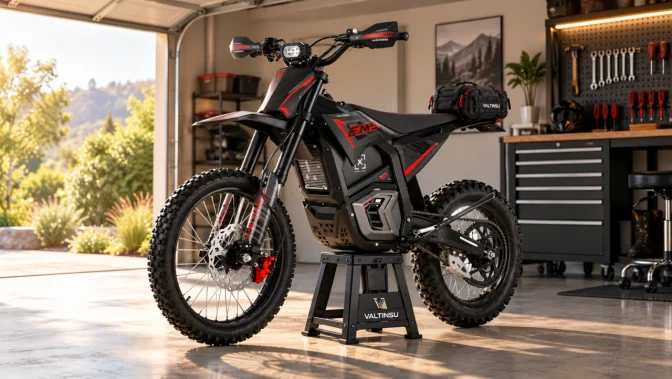
Electric Dirt Bike Throttle Not Working: What to Check First
If an electric dirt bike throttle does not respond, do not assume the throttle has failed. First determine whether the whole bike has lost drive or whether a startup state, ride mode, brake-cutoff input, error condition, connector, or throttle fault is preventing response.
The first checks are external and cost nothing: stabilize the bike, confirm the display state, release both brakes, and record any code before power-cycling. Powered wheel-off-ground testing is not part of owner troubleshooting unless the exact manufacturer procedure explicitly requires it.
On Valtinsu models whose current manual specifies startup in gear 0, the motor will not drive until an enabled ride gear is selected. Confirm the behavior in the manual for the exact model and firmware rather than assuming the throttle is defective.
This guide works through the fault the way a technician would. Safety first, then whether the problem is really throttle-only, then power state, interlocks, settings, the throttle itself, wiring, and error codes. Parts come last, not first.
First determine whether the bike has power, whether another documented drive function works, and whether a brake or startup interlock is active. Do not buy a throttle until the symptom is isolated to its input path.

Six fault groups cover nearly every case: the bike is not in a ride-ready state, a brake or safety interlock is active, the battery or power path is the problem, the throttle or its wiring is damaged, a controller input has failed, or the system is in a protection mode.
Only one branch is a failed throttle. The others are ride-ready state, supply, safety input, wiring, or controller conditions that a new throttle will not fix.
First Determine Whether the Bike Has Power
Check the display, the lights, the battery indicator, and whatever else normally comes alive at start-up. No display means the problem is upstream of the throttle entirely.
Then Determine Whether Only the Throttle Has Failed
If the motor still runs in another approved mode, the fault narrows sharply. If nothing drives the motor at all, you are looking at a shared problem rather than a throttle problem.
Do Not Keep Twisting an Unreliable Throttle
Delayed response, sticking, surging, or intermittent power are not conditions to test your way through. Stop and diagnose. A throttle that behaves unpredictably can command power when you do not expect it.
Stop and Make the Bike Safe Before Troubleshooting

An unresponsive throttle and an unintended-acceleration fault can be the same fault at different moments. Set up so a surprise cannot hurt you.
Move the bike to a flat area, power it down as the manual specifies, remove the key, and keep hands away from the chain and wheels. Do not raise a drive wheel for a live throttle test.
Get off slopes, away from people, vehicles, trail junctions, and loose surfaces before you touch anything. The EM-5 manual makes the same point in its pre-ride section: be in an open, safe area before turning the throttle.
Power Down Before Touching Connectors
Follow your shutdown procedure, remove the key, and set it aside where you can see it.
One habit worth building on an electric machine: silence is not proof the drive is disabled. There is no idling engine to warn you, so treat the bike as live until power is properly isolated.
Stop Immediately for Unexpected Acceleration
A throttle that sticks, surges, responds late, or keeps driving after release is finished for the day. The CPSC has recorded unintended acceleration and throttle-related incidents in its own e-bike rulemaking, so this is a documented failure mode rather than a theoretical one.
Identify Which Throttle Failure You Actually Have
Five patterns, five different shortlists. Work out which one you have before reading any further.
The Throttle Turns Normally, but Nothing Happens
Check this pattern in a low-cost order: ride-ready state, selected gear, brake and safety interlocks, throttle movement, wiring, connector, then controller input.
The Throttle Is Physically Stuck or Will Not Turn

This is a mechanical problem, not an electrical one. Look for crash damage, a shifted grip, debris, a damaged housing, or a control clamped in the wrong position.
Do not force it. Forcing a bound throttle can damage the return spring or the internal sensor and turn a cheap fix into a parts order.
The Throttle Works Only Sometimes
Intermittent faults point at wiring strain, a partly seated connector, moisture, or a protection state that comes and goes. Note exactly when it drops out.
The Throttle Works Until You Brake
Power cutting during braking is the cutoff system doing its job. The fault is when power does not come back afterward, which points to the brake signal or the lever not returning.
The Throttle Causes Jerking or Unexpected Motor Response
Treat irregular output as a safety-critical control fault. Stop riding, record what happened, and get it diagnosed rather than trying to ride around it.
Check Whether the Whole Bike or Only the Throttle Is Affected
Other functions are free diagnostic evidence. Use them before you open anything.
The Display and Lights Are Also Off

Start with the battery, its seating, and the main power path, not the throttle. On Valtinsu bikes, the main power connector sits under the seat, which the key opens, so confirm it is fully home. Every model in the three-ride-mode lineup needs that connection made before anything works.
If the display is on but no drive function works, inspect shared causes first: startup state, active safety inputs, low-voltage protection, a system code, or a power/controller fault.
Now you are looking at something shared: a drive inhibit, a controller fault, a battery protection event, a motor fault, or broader wiring damage.
A lit display only proves the low-voltage side is alive. It does not prove the bike is ready to drive.
If another documented drive function works while the throttle does not, the throttle's settings, wiring, connector, and input become more likely. Use only functions actually provided on the exact model.
This moves throttle settings, throttle wiring, the throttle sensor, and the throttle-specific controller input to the top of your list.
It does not fully clear the controller, however. A controller can drive a motor through one input and still have a failed input elsewhere.
If the exact model has a documented low-speed or walk function and it works, the controller and motor can respond to at least one command. That supports—but does not prove—a throttle-specific fault.
Useful evidence. It shows the controller can command the motor, which rules out a dead motor and a dead output stage. The throttle circuit itself is still unproven.
Check Battery, Startup, and Ride-Ready Status
Startup and ride-ready checks should come before parts because they are external, reversible, and model-specific.
Confirm the Selected Gear or Mode

A non-driving startup state is a high-value check only when the exact model documentation identifies one.
The cited EM-5 manual describes a gear-0 startup state in which the display is on but drive is not enabled. Confirm the exact procedure for EM-5 Pro, EM-5 Ultra, EM23, or another display revision rather than assuming the same behavior.
If the bike is in a documented non-driving state, select the permitted ride-ready state exactly as the manual instructs before diagnosing the throttle hardware.
Confirm Battery State of Charge
A very low pack can enter protection and limit or cut propulsion. The CPSC describes how a battery management system compares voltage, current, and temperature against cell limits and disconnects the cells when a limit is exceeded.
Watch for an undervoltage icon or an E06 code at the same moment the throttle stops working.
Confirm the Battery Is Fully Seated and Locked

Look for a pack that moves under hand pressure, damaged external contacts, or a battery that was disturbed during transport or a charge cycle.
Complete the Normal Startup Sequence
Key position, power switch, any kill switch, and the gear selection all have to be right. Some machines also expect a specific order.
Do Not Assume a Lit Display Means Ready to Drive
Worth repeating because it catches so many people. Display power and drive permission are two separate things on these bikes.
Check Ride Mode and Throttle Settings

A documented display setting can block or delay throttle response, but menu names and parameter numbers are model- and firmware-specific.
Record existing values before any approved change and use only the settings table for the exact display and bike.
|
Setting |
Function in the cited EM-5 display manual |
How it can resemble a throttle fault on that system |
|
Power gear (P05) |
Which gear numbers exist, including whether gear 0 is available |
A gear scheme that starts at 0 leaves the bike in a non-driving gear at every switch-on |
|
Speed limit (P08) |
The maximum speed the controller will allow |
Set very low or to zero; the throttle produces no useful drive |
|
Zero start / non-zero start (P09) |
Whether the throttle works from a standstill or only once moving |
On non-zero start, the throttle does nothing until the bike is already rolling |
|
Voltage level (P03) |
The pack voltage the display and controller expect |
A mismatched value can trigger protection or wrong readings |
The Non-Zero Start Setting Is Model-Specific
The cited EM-5 display manual describes a non-zero-start option that can require movement before throttle response.
Treat P09 as an EM-5 manual example, not a universal Valtinsu setting. Confirm the exact display revision before changing it.
If the behavior matches the documented setting, restore the approved value rather than replacing the throttle.
Confirm the Current Ride Mode
Confirm the current ride mode against the exact model's manual. A low mode can soften response, but it should not be used as proof of a throttle fault.
Do not change hidden controller or display parameters using a generic code list. Record existing values and use only settings documented for the exact display and bike.
Stay in the documented menu. Undocumented parameters can alter current limits, speed control, and safety behavior, and you may not be able to put them back.
Rule Out Brake and Other Safety Interlocks
A brake cutoff is one possible drive inhibit. Depending on the exact model, other manufacturer-fitted interlocks may also block throttle response.
Check Brake Lever Return

A lever that does not return fully can leave the motor inhibit signal active, so the bike thinks you are still braking while you twist the throttle.
Mud, impact, a bent lever, or a displaced external sensor component can hold a brake signal active. In the cited EM-5 manual, E02 identifies the brake branch; confirm the exact model before applying that code.
Look for Brake Warning Indicators
Check whether the brake icon stays lit with the levers released, and whether the brake light behaves normally. Either one tells you what the system currently believes.
Check Other Manufacturer-Fitted Interlocks
Depending on the exact model, the drive-enable chain may include a key state, start input, brake cutoff, stand switch, or another interlock. Check only components documented for that bike.
Do Not Permanently Bypass Safety Inputs
Do not unplug or bypass a safety input to restore drive. That can create unexpected acceleration and removes an important control function.
Use the interlock as evidence. Do not defeat it.
Inspect the Throttle Mechanically
A quick hands-on check separates a physical problem from an electrical one.
Check Smooth Movement
The throttle should move through its travel without grinding, binding, sudden free play, or unusual noise.
Confirm Normal Return

The MSF pre-ride standard sets the bar here in one line: the throttle should move freely, snap closed, and produce no revving when the handlebars are turned. Slow or incomplete return is a stop-riding condition.
That last part about turning the bars is doing double duty. It catches harness strain as well as throttle binding.
Look for Grip or Handlebar Interference
A rotated grip, a handguard, a bar-end, or a crash-shifted control can physically block throttle movement. Check clearance through full travel.
Inspect for Mud, Sand, or Impact Damage
Look for contamination and visible damage around the housing. Do not open the throttle body unless your documentation says you may.
Inspect External Throttle Wiring and Connectors
This is where genuine throttle faults concentrate, and the reason is the steering head.
Follow the Throttle Cable From the Handlebar
Look for cuts, pinching, abrasion, stretching, and sharp bends. Work along the whole visible run rather than glancing at the plug.
Pay Special Attention to the Steering Area

Every steering input flexes the harness at the same place. Published work on connector failure describes the loop that follows: fretting corrosion from vibration and movement raises contact resistance, heat accelerates the damage, and the connection degrades.
If throttle response changes with steering position, prioritize the steering-area harness, but treat that as a correlation until the wiring and connectors are inspected.
Inspect Accessible Connectors
Look for housings that are not fully latched, bent or pushed-back pins, moisture, dirt, corrosion, and damaged seals.
Check Recent Service or Shipping Areas
If the fault began after assembly, transport, a tire change, handlebar work, or a fall, inspect whatever was disturbed during that event first. Bars rotated for shipping are a common culprit.
Do Not Force Mismatched Connectors
Plugs that look alike can carry different pinouts. Forcing one can damage a controller input that was perfectly healthy a minute earlier.
Read the Error Codes Before You Change Any Parts

Read and photograph the display before replacing parts. A code gives a model-specific inspection branch but does not prove the named component is defective.
The table below is based on the cited EM-5 manual revision. EM-5 Pro, EM-5 Ultra, EM23, and different display firmware may use different settings or code definitions, so verify the exact manual.
For an EM-5 covered by that revision, E02, E06, E08, and E09 can help separate brake, supply, throttle, and controller branches. Use the full symptom with the code.
|
Code |
Meaning in the cited EM-5 manual |
What it means for a throttle complaint |
|
E00 |
Normal status |
No fault logged, so look at gear selection, settings, and interlocks |
|
E02 |
Brake |
A brake input is active. Check lever return before anything else |
|
E03 |
Assist sensor failure |
Assist sensing path, not the throttle itself |
|
E06 |
Battery undervoltage |
Protection is limiting drive. Charge and recheck |
|
E08 |
Throttle failure |
The throttle signal path is the prime suspect |
|
E09 |
Controller failure |
Points away from the throttle. Do not replace throttles chasing this |
Record the Exact Error Before Resetting Anything
Photograph the display. Note the code, the battery level, the gear, the mode, and what you were doing. A cleared code with no record is evidence thrown away.
Note What Happened Just Before the Fault
Water exposure, a fall, battery removal, hard acceleration, a long climb, or recent service all narrow the diagnosis considerably.
Use the Symptom Pattern to Narrow the Fault
Match your pattern to a shortlist, and you skip most of the guesswork. Use the table as an inspection order, not a verdict.
|
Symptom |
What to check first |
|
Another drive mode works, throttle does not |
Throttle settings, connector, wiring, throttle sensor and its controller input |
|
Walk mode works, throttle does not |
Throttle-specific input or a display setting |
|
Nothing drives the motor at all |
Shared controller, power path, interlock, motor or system fault |
|
Throttle works only once the bike is moving |
The non-zero start setting, P09 |
|
Throttle does nothing at every switch-on |
Gear selection sitting at 0 |
|
Throttle drops out when the bars are turned |
Handlebar-area wiring and connector strain |
|
Throttle dead after braking |
Brake cutoff signal and lever return |
|
Fault began after rain or a wash |
Moisture and connector contamination |
|
Fault began after a crash or shipping |
Physical damage, harness strain, displaced connector |
|
Throttle sticks or returns slowly |
Mechanical binding. Stop riding |
How to Test an Electric Dirt Bike Throttle Safely
There is a firm line between manufacturer-approved diagnostics and poking a multimeter into live pins. Stay on the right side of it.
Start With Built-In Diagnostics
Display codes, any diagnostic menu, and dealer tools come first, because they cost nothing and cannot damage anything.
Do Not Assume Universal Throttle Voltages
Do not rely on fixed throttle-signal voltages from a generic article. Supply voltage, pinout, signal range, and connector layout vary by controller and throttle.
Supply voltage, signal range, sensor architecture, and pinout vary between systems, and a Hall-based throttle behaves differently from a potentiometer type. Chasing a number from someone else's bike will send you down the wrong path.
Avoid Back-Probing Unknown Live Connectors
Shorting a signal, supply, or ground pin can destroy a controller in an instant. Controller five-volt supplies are low current and unforgiving.
Use Manufacturer Support for Advanced Testing

For advanced testing, send the exact code, model, display and controller identifiers, connector photos, and symptom timeline to support. Do not open sealed housings merely to obtain a measurement.
Does the Throttle Need to Be Reset or Unlocked?
A 'reset' or 'unlock' request often describes a startup state, documented mode, interlock, or setting rather than a failed throttle.
Most Throttles Have No Independent Reset
The throttle is an input. Most versions have no independent reset; follow only the bike-level restart or fault-clear sequence in the exact documentation.
Use the Official Power-Cycle Procedure
If your documentation gives a restart or fault-clear sequence, follow it exactly. Repeatedly cycling power to clear a returning code is not a repair.
Unlocking Usually Means Enabling a Documented Feature
A no-response condition may come from a non-driving gear, restricted mode, documented start setting, or active interlock. Which of these exists depends on the exact model and firmware.
Do Not Use Hidden Menus to Defeat Restrictions
Do not use hidden menus to defeat speed or throttle restrictions. For any public-road use, verify vehicle classification, equipment, registration, and local law rather than relying on a blanket street-legal claim.
Know When the Throttle Itself Is the Likely Fault
Four signs justify pointing at the throttle. Fewer than four, keep looking.
Physical Damage
Cracks, a broken return action, a damaged housing, or binding through travel are all clear cases.
Response Tied to Throttle Position
A throttle that only works at a certain angle, or cuts in and out consistently as you move it, suggests an internal or cable fault.
An E08 Code With Everything Else Checked
An E08 code in the cited EM-5 manual moves the throttle circuit up the list, but the cause can still be binding, wiring, a connector, startup position, or the throttle itself.
Replace With the Exact Compatible Part

A matching plug is not proof of compatibility. Pinout, supply voltage, signal type, and controller logic can all differ, and thumb and twist units are not interchangeable across every model. Source replacement throttles and control parts specified for your bike rather than a generic unit from a marketplace listing.
When the Controller or Another Part May Be the Problem
If an approved replacement throttle produces the same symptom, return to shared wiring, interlocks, controller input, and system diagnostics instead of buying another throttle.
The Throttle and Other Inputs Fail Together

When nothing commands the motor, look at the controller, the power path, the interlocks, and the motor. Current capability differs across the range, and the 60V EM-5 Pro runs different hardware from the entry bike, so match any replacement part to your own model.
The Controller Shows Damage or Repeated Errors
A burnt smell, obvious heat, water exposure, or a returning E09 needs service. Replacing throttles will not fix it.
A Known-Good Throttle Behaves the Same
If an approved replacement changes nothing, stop buying throttles and keep diagnosing. That result is information, not bad luck.
Stop Riding and Contact Support for These Symptoms
Five conditions end the DIY stage.
- The throttle sticks or returns slowly. Any control that can command power unpredictably needs service first.
- The bike accelerates without a throttle command. Unexpected propulsion is safety-critical, full stop.
- Power continues while braking on a system designed to inhibit drive during braking, which needs immediate diagnosis.
- Wiring is burnt, melted, or wet inside a connector. Stop testing and have the electrical system inspected.
- Error codes keep returning after a proper reset. Repeated faults need diagnosis, not repeated clearing.
It is also worth checking whether your machine has an open recall. The CPSC publishes micromobility recall notices and email alerts, and throttle and controller defects have been recalled before on electrical ride-on products.
Prevent Future Throttle Problems
A few routine checks reduce repeat faults.
Check Throttle Return Before Every Ride

Before riding, confirm smooth movement, a clean spring return, no interference, and no change when the bars move. Also confirm the documented gear or drive-ready state for the exact model.
Inspect Handlebar Wiring After Falls or Transport
Steering, tie-down points and rotated bars all stress the harness at the same spot. Look there first after any of the three.
Keep Electrical Areas Clean and Dry
Wash by hand around the throttle, connectors, display, and battery contacts. Pressure washers force water past seals that were never designed for it.
Document Repeat Problems
Keep photos, codes, dates, and trigger conditions. A short log turns an intermittent complaint into a serviceable fault report.
Final Takeaway
An electric dirt bike throttle that does not work is far more often a state than a failure.
Make the bike safe. Confirm the gear is above zero and the mode is sensible. Check battery, seating, and startup. Rule out brake and safety interlocks. Check that the throttle moves and returns. Follow the harness through the steering area. Read the error code. Only then think about parts.
Work in that order and replace the throttle only when the evidence isolates its circuit and the exact compatible part is known.
FAQs
Why is my electric dirt bike throttle not responding?
First determine whether the whole drive system is inactive or only the throttle input has failed. A non-driving gear, documented start setting, active brake cutoff, low-voltage protection, or another interlock can block drive even when the throttle is healthy.
• Display off: check the main power and startup path.
• Display on, no drive in any mode: check shared interlocks and system faults.
• Only throttle fails: inspect its movement, cable, connector, and model-specific status code.
How do I reset an electric dirt bike throttle?
Most throttles have no separate reset. Use only the documented bike-level power-cycle or fault-clear procedure for the exact model.
If a code returns after a normal restart, record it and diagnose the cause. Repeated resets can erase useful evidence without repairing the fault.
Why does the throttle work only after the bike starts moving?
A documented non-zero-start setting can require movement before throttle input is accepted. The P09 description in the cited EM-5 manual is an example, not a universal setting for every Valtinsu model or display revision.
Confirm the exact manual and current setting before changing anything. Do not use hidden menus or generic parameter lists from another display.
Can a brake cutoff sensor make the throttle seem dead?
Yes. If the system sees an active brake signal, it can block motor output even with the lever released.
- Check that the lever returns freely.
- Look for the model's brake indicator or status code.
- Inspect accessible sensor wiring and any external magnet only as documented.
- Do not bypass the cutoff to keep riding.
How should an electric dirt bike throttle be tested?
Start with built-in diagnostics and an unpowered external inspection. Live voltage ranges and pinouts are not universal, so advanced measurement requires the exact service data and suitable equipment.
Do not back-probe an unknown connector or run a powered test with hands near the chain or wheel. A technician can test the signal safely when owner documentation stops at external checks.
Should I replace the throttle when E08 appears?
Not immediately. In the cited EM-5 manual, E08 identifies the throttle circuit, but the cause can be mechanical binding, wiring, a connector, startup position, or the throttle itself.
Confirm the code against the exact model and manual revision, inspect the accessible signal path, and replace parts only after the fault is isolated.
Sources
- U.S. Consumer Product Safety Commission, Electric Bicycles: Advance Notice of Proposed Rulemaking (Federal Register, 2024)
- U.S. Consumer Product Safety Commission, Micromobility: E-Bikes, E-Scooters and Hoverboards (CPSC, 2026)
- U.S. Consumer Product Safety Commission, Safety Standard for Lithium-Ion Batteries Used in Micromobility Products (Federal Register, 2026)
- Motorcycle Safety Foundation, T-CLOCS Pre-Ride Inspection Checklist (MSF)
- Valtinsu, EM-5 Owner Manual: Display Settings and Vehicle Status Codes
- Texas Instruments, Brushless DC Motor Commutation Using Hall-Effect Sensors, SLVAEG3B (2022)
- Engineering Failure Analysis, Mechanisms of Failure and State Analysis of Electrical Connectors in Automobiles (Elsevier, 2025)


Looking for something else?
Electric Dirt Bike Replacement Parts Availability: What Buyers Should Verify Before Ordering
LEARN MORE
How to Check an Electric Dirt Bike for Safety Recalls by Model and Serial Number
LEARN MORE
How to Choose an Electric Dirt Bike Repair Shop: Questions to Ask Before Service
LEARN MORE
How to Lift a Fallen Electric Dirt Bike Without Hurting Yourself or the Bike
LEARN MORELooking for something else?
Electric Dirt Bike Fall Riding on Wet Leaves: Grip, Hidden Obstacles and Braking
LEARN MORE
Electric Dirt Bike Trailside Power Loss: Recovery Plan When the Battery Is Dead
LEARN MORE