California electric dirt bike laws: Helmet Rules, Street Use & Off-Road Riding
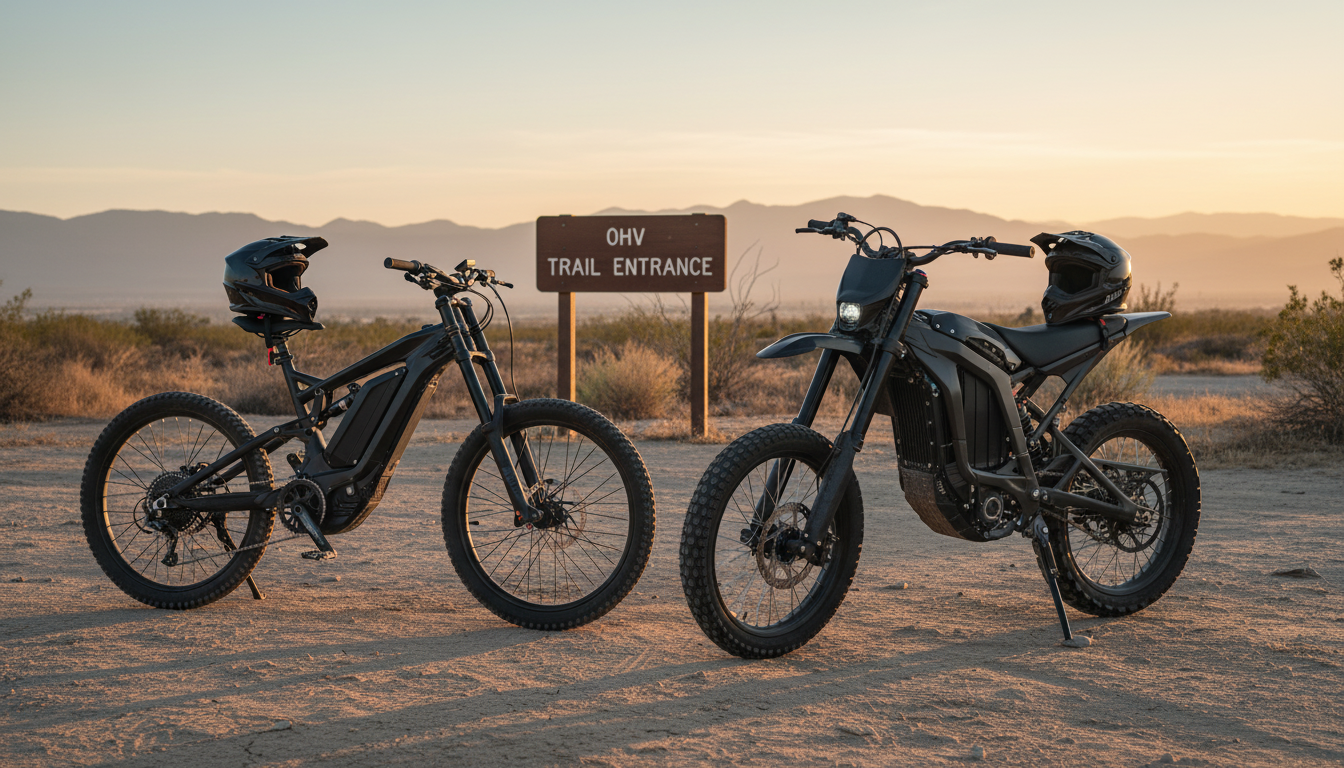
Park two electric dirt bikes next to each other. Same frame, same wheels, maybe the same paint. One is an e-bike in the eyes of California. The other is an eMoto, and the gap between those two words is where the tickets come from. Helmet, license, registration, where you can ride. All of it hangs on that one call.
The rules got sharper on January 1, 2026. Under California electric dirt bike laws, this distinction also defines the electric dirt bike vs e-bike classification, deciding whether a ride is treated as a bicycle or an off-highway motorcycle. Pedals and a small motor? Electric bicycle. No pedals, big power, dirt build? That is an adult electric off-road motorcycle, an eMoto, and the state now files it as an off-highway vehicle. We laid the comparisons out side by side below. Sort your own bike before a deputy does it for you at a trailhead.
Same shape on the surface. Different rulebook underneath. Here is every matchup that decides which one you own.
Electric Dirt Bike vs E-Bike: The Core Split
In legal terms, this category is often referred to as an eMoto, depending on configuration, and may fall under California Vehicle Code sections 312.5 and 436.1, which define how these vehicles are classified and regulated. Everything else hangs on this one. Pedals and a motor under 750 watts gets you a bicycle. An electric dirt bike rarely has either, so it drops out of the bicycle world and lands in the off-highway motorcycle pile.

The listing copy is irrelevant here. California reads pedals, power, speed, and how the thing was built. Fail any single one of those and you are no longer holding an e-bike.
|
Factor
|
Electric Bicycle (e-bike)
|
Electric Dirt Bike (eMoto)
|
|
Pedals
|
Required, fully working
|
None from the factory
|
|
Motor power
|
Under 750W
|
Often well over 750W
|
|
Top assist speed
|
20 mph (Class 1/2), 28 mph (Class 3)
|
No assist cap; motor-driven
|
|
Legal class
|
Bicycle (CVC 312.5)
|
Off-highway motor vehicle (CVC 436.1)
|
|
Where it rides
|
Bike lanes, roads, many trails
|
OHV areas, private land only
|
|
Registration
|
None
|
DMV Green Sticker on public land
|
SB 586 added the eMoto definition to the Vehicle Code, and SB 1271 made it illegal to sell or label a non-qualifying machine as an e-bike. (Source: California Legislative Information, SB 586, 2025)
|
Fast rule
No pedals plus more than 750 watts equals eMoto. Assume off-road only, assume a Green Sticker on public land, assume a helmet. You can adjust in your favor later, but starting there keeps you legal.
|
Off-Road Riding vs Street Riding
Say the bike is an eMoto. Now the question shifts from paperwork to place. Off-road and on-road are two separate legal worlds, and most electric dirt bikes carry a passport for only one of them.

Where Each One Is Allowed
The OHV bulletin is blunt: off-highway electric motorcycles may not be operated on highways, streets, sidewalks, bike paths, bike lanes, or off-street parking, and cannot be modified to become street legal. (Source: CA State Parks OHMVR, OHV Bulletin 25-1, 2025)
|
Location
|
eMoto / Electric Dirt Bike
|
Street Electric Motorcycle
|
|
Public roads
|
Not allowed
|
Allowed if registered
|
|
Sidewalks / bike lanes
|
Not allowed
|
Not allowed
|
|
Neighborhood streets
|
Not allowed
|
Allowed if registered
|
|
OHV parks / SVRAs
|
Allowed with Green Sticker
|
Varies by park
|
|
Private property (permission)
|
Allowed, often no ID needed
|
Allowed
|
|
License needed
|
None off-road
|
M1 motorcycle license
|
Your street counts as a public road. Loop the block once on a non-street-legal eMoto and the same citation applies that you would catch on the freeway. Quiet motor, same ticket.
750W vs 3000W: Where the Power Line Falls
Watts tell you fast where a bike lands. 750 is the wall between bicycle and motor vehicle. Most electric dirt bikes sit way over on the wrong side, and it is not close.

|
Question
|
750W (with pedals)
|
3000W electric dirt bike
|
|
E-bike eligible?
|
Yes, if pedals + class rules met
|
No, far over the limit
|
|
Pedals present?
|
Required
|
Usually none
|
|
Typical class
|
Class 1, 2, or 3 e-bike
|
eMoto / OHV (or moped/motorcycle)
|
|
Street legal?
|
Yes, within e-bike rules
|
Not as built; off-road only
|
|
Registration
|
None
|
DMV Green Sticker for public land
|
|
License
|
None
|
None off-road; M1 for any road use
|
A 750W badge does not clear a bike everywhere. It still has to pass speed, pedal, and equipment rules. The 3000W machine sold for dirt? Off-highway vehicle, full stop, unless the maker can show road certification.
How Sur-Ron, Talaria, and Similar Bikes Compare
The state calls them out by name. Sur-Ron, Talaria, the rest of the high-power crowd, all listed in the OHV bulletin as off-highway electric motorcycles. Stand one next to an e-bike and you see it instantly. No pedals. Big wattage. Built for dirt. Sold for off-highway use means not street legal, and the burden sits on the seller to prove otherwise.
Green Sticker vs Red Sticker
This is the part that ambushes honest riders. E-bike: no registration, ever. eMoto: DMV off-highway identification on public land, and which sticker you get depends on the machine itself.

|
Item
|
Green Sticker
|
Red Sticker
|
|
Typical use
|
Year-round OHV riding
|
Seasonal / certain vehicles
|
|
Fits electric eMotos?
|
Yes, the standard for eMotos
|
Rare for electric
|
|
Where it rides
|
Any OHV area, when allowed
|
OHV areas during open season
|
|
Issued by
|
California DMV
|
California DMV
|
|
Required on public land?
|
Yes
|
Yes (where applicable)
|
Because eMotos are electric, the Green Sticker is the standard. Keep proof of current OHV status with the bike, since expired identification becomes a problem fast at a checkpoint. (Source: California DMV, Register an OHV, 2026)
Public Land vs Private Property
There is one exception, and it is narrow. Ride only on private property under the owner's control and permission and you may skip the OHV ID. Open that land to the public and the rule snaps right back. Visiting from another state? You may still need a California nonresident OHV use permit if your home-state identification does not carry over.
Helmet and Age Rules: Youth vs Adult
Helmet rules bend with class, age, and where you ride. For gift buyers the youth-versus-adult split is the one that matters. On public OHV land with an eMoto, though, the rule is flat: helmet, everyone, every time.

|
Rider / bike
|
Helmet rule
|
Notes
|
|
eMoto on OHV land
|
Required, all ages
|
SB 586 subjects eMotos to OHV rules
|
|
Street e-motorcycle
|
DOT helmet, all ages
|
Rider and passenger
|
|
Class 3 e-bike
|
Required, all ages
|
Assists up to 28 mph
|
|
Class 1/2 e-bike
|
Required under 18
|
Older riders strongly advised
|
The CHP confirms SB 586 subjects eMotos to OHV rules, helmets included. (Source: California Highway Patrol, 2026) Off-road crashes happen at low speed too, in a turn or on loose dirt, so a real helmet earns its place every ride.
|
Parents, read this twice
A small-looking electric dirt bike can still be a regulated motor vehicle, and some youth models fall under OHV rules. Confirm the class, pick a legal riding space, and require a helmet every ride. A parent can be cited if a child rides illegally on a public road.
|
Aftermarket Conversion vs Dual-Purpose From the Factory
Plenty of riders try to bolt their way across the off-road gap. Lights, mirrors, a horn. California shuts that down. What actually matters is the difference between a conversion and a bike that left the factory built for both.
|
Approach
|
Converted off-road bike
|
Factory dual-purpose
|
|
Origin
|
Built for off-highway use
|
Built for road + off-road
|
|
Add lights / mirrors
|
Does not change class
|
Already road-equipped
|
|
Add pedals
|
Still not an e-bike
|
N/A
|
|
Street registration
|
Not eligible
|
Eligible if it meets road rules
|
|
California verdict
|
Stays off-road only
|
Can be street legal
|
The OHV bulletin and the DMV manual say the same thing. A vehicle built for off-highway use cannot be converted for the road unless it was made dual-purpose to begin with. The factory drawing decides it. Not the parts box.
Before You Buy: Match the Bike to the Law
This California electric dirt bike laws buying checklist helps readers confirm whether a bike is an eMoto, OHV, or street-legal motorcycle before making a purchase, instead of assuming specs alone decide legality. Trouble usually starts at checkout, not on the trail. Before you pay, nail down the motor rating, top speed, pedals, factory label, and registration status, and get any road claim in writing. Still deciding between models? Compare the full lineup on power, age rating, and the terrain you actually ride.
Take a value brand like Valtinsu. Its EM-5 beginner model runs 48V, 40 mph, age 13+. The adults-only EM-5 Pro pushes 60V 5600W, 52 mph, 18+. Both are sold off-road only, both not street legal, which is exactly the honest framing the new rules expect. No pedals plus that kind of power lands them on the eMoto side of every table up above. So plan for OHV areas and a Green Sticker. Not a morning commute.

How We Researched This Guide
We work with adult electric dirt bikes and we read these rules the way a buyer does. So this came from the primary sources, not somebody else's summary of them.
Primary Law vs Hearsay
Each legal point traces back to SB 586, the Vehicle Code sections, the State Parks OHV bulletin, the DMV, or the CHP. When a source got vague, we took the stricter reading.
Live Specs vs Stale Listings
Bike numbers were checked against the live manufacturer pages. Old spec versus current page, the current page wins every time.
Written for Riders and Parents
Plain language on purpose. The people who get cited are new riders and gift buyers, not attorneys. None of this is legal advice either. Rules shift, and local agencies pile on their own.
The Bottom Line
California's whole rulebook is a string of either-or calls. E-bike or eMoto. Off-road or street. 750W or 3000W. Sticker or none. Converted or dual-purpose. Get each one right and the confusion drains out of it.
For most electric dirt bikes the answers stack up identical: eMoto, off-road only, Green Sticker, helmet, no street conversion. That is not a loophole to argue around. It is the lane the law drew.
Right bike, right place. Want pavement? Buy a real street motorcycle or a compliant e-bike. Want dirt? Get an off-road machine, register it for OHV use, strap on a helmet, keep that sticker current. Done.
FAQs
Can I ride my electric dirt bike in my neighborhood?
Usually no. A high-power off-road model turns your quiet side street into a public road in the eyes of the law, and quiet does not equal legal. The bike being silent buys you nothing here.
Real e-bikes are the exception. Working pedals, under 750W, fits a California class? Then it rides where bicycles ride, though your city can still pile on its own rules.
Quick gut check:
-
No pedals or big power means keep it off public roads
-
A true Class 1 or 2 e-bike is usually fine where bikes go
-
Quiet motor: your neighbors will thank you, the cop won't care
Electric dirt bike vs e-bike: what is the legal difference?
Pedals and power. That is the whole test. An e-bike needs working pedals and has to stay under the state motor limit. Most electric dirt bikes are built like small motorcycles, so they fall somewhere else entirely.
Where it bites you is on the ride. The e-bike gets streets and bike lanes. The dirt bike gets private land or an approved OHV trail, and not much in between.
The split:
-
E-bike: pedals, legal power, bicycle-style use
-
Electric dirt bike: more power, dirt build, motorcycle-style use
-
Different class drags different rules behind it, helmets, registration, where you ride
Is a 3000W ebike street legal?
Almost never. 3000W sits way above what California calls an e-bike. Looks like a dirt bike, rides like one? Then bike lanes and around-town riding are off the table.
Sellers keep slapping "e-bike" on these. The label is not the law. California reads the actual build: motor power, pedals, speed, and whether the thing was ever made for the road.
Before you ride it:
-
Motor over 750W?
-
Real working pedals, or none?
-
Built for street, or built for dirt?
-
Can the seller actually prove it is highway-legal?
750W vs 3000W: which can I actually ride on the street?
The 750W one, maybe. Only if it clears the full e-bike rules though, working pedals, the right speed cap, the correct class. Power alone does not get you there.
A 3000W dirt-style bike lives in another category. Built for off-road, not bike lanes or sidewalks. Bolting on a headlight does not move it.
Short version:
-
750W with pedals and class rules: street riding may be fine
-
3000W dirt build: off-road only, almost always
-
Added parts help, they do not rewrite the law
What are the new ebike laws in California 2026?
The line between e-bikes and off-road electric motorcycles just got drawn in bold. A lot of high-power electric dirt bikes are now eMotos, which means they follow off-highway vehicle rules instead of the friendly e-bike ones.
This one matters for parents especially. A Sur-Ron or Talaria-style machine is nothing like a pedal-assist commuter, even if both run on a battery. Ride it on public OHV land and it may need DMV identification.
The main points:
-
eMotos get treated as off-highway vehicles
-
Public OHV riding may need a Green Sticker or DMV ID
-
A high-power dirt bike should not be sold as a plain e-bike
-
Check the specs before you pay
Can I make an electric dirt bike street legal?
Usually no. Built for off-road means adding street parts later often changes nothing. California looks at how the bike left the factory, not what you bolted on after.
Lights, mirrors, signals, sure, they help you stay safe. They do not turn an off-road eMoto into a street motorcycle. Adding pedals later does not save it either if the motor is too strong or it was never an e-bike to begin with.
What to remember:
-
Lights and mirrors do not guarantee a thing legally
-
Pedals added after the fact do not make a high-power bike an e-bike
-
Factory dual-purpose is the safer route
-
Get proof before you trust a seller's pitch
Do you need a license for an electric dirt bike in California?
Depends where you ride. Off-road in an approved area, a regular driver's license usually is not the sticking point. OHV registration or a Green Sticker is the thing to worry about.
Public road changes the math. A motorcycle-style electric dirt bike can need a motorcycle license plus road registration. And if the bike is not street legal, your license does not rescue the ride.
Three things to pin down first:
-
What is it: e-bike, eMoto, moped, or motorcycle?
-
Where are you riding: private land, OHV trail, or public road?
-
What paperwork: e-bike label, OHV ID, or road registration?
What happens if the police catch you riding illegally?
Could be more than a wave-off. Street riding, wrong registration, wrong license, banned area, any of those can land a ticket, and sometimes the bike gets towed.
The trouble usually starts the same way: someone rides an off-road dirt bike like it is a regular e-bike. Neighborhoods, bike lanes, sidewalks, city parks, that draws eyes fast. Even a public OHV area bites if the bike has no proper ID.
Common reasons riders get stopped:
-
Non-street-legal eMoto out on public roads
-
No motorcycle license where the law wants one
-
Missing Green Sticker or OHV ID on public land
-
Sidewalks, bike paths, trails where motors are banned
Sources
-
California State Parks OHMVR Division, OHV Information Bulletin 25-1: SB 586 Electric Motorcycles (2025)
-
California DMV, DMV Highlights New Laws in 2026 (2026)
-
California Legislative Information, Senate Bill 586, Off-Highway Electric Motorcycles (2025)
-
California DMV, Register an Off-Highway Vehicle (OHV) (2026)
-
California Highway Patrol, New Year, New Laws: Public Safety Laws Taking Effect in 2026 (2026)


Looking for something else?
Electric Dirt Bike Replacement Parts Availability: What Buyers Should Verify Before Ordering
LEARN MORE
How to Check an Electric Dirt Bike for Safety Recalls by Model and Serial Number
LEARN MORE
How to Choose an Electric Dirt Bike Repair Shop: Questions to Ask Before Service
LEARN MORE
How to Lift a Fallen Electric Dirt Bike Without Hurting Yourself or the Bike
LEARN MORELooking for something else?
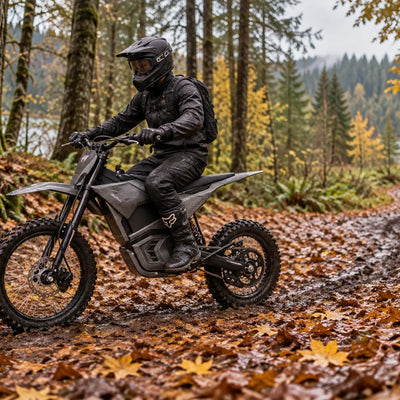
Electric Dirt Bike Fall Riding on Wet Leaves: Grip, Hidden Obstacles and Braking
LEARN MORE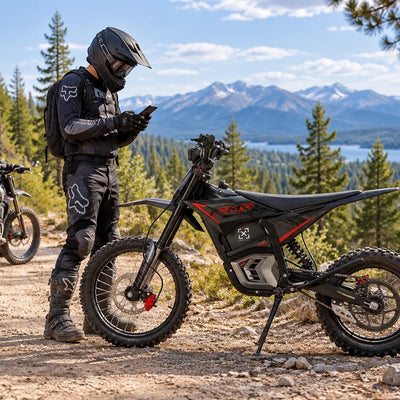
Electric Dirt Bike Trailside Power Loss: Recovery Plan When the Battery Is Dead
LEARN MORE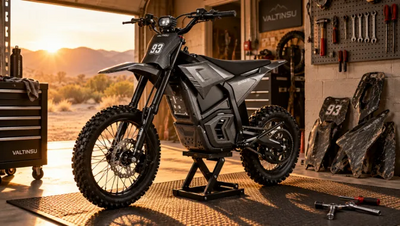
Electric Dirt Bike Plastics Replacement Guide: Fitment, Color Kits and Install Order
LEARN MOREYou may also like
Moto eléctrica todoterreno para adultos EM-5 con luz
€1.299,00
€1.599,00
VALTINSU EM-5 Pro Off-Road Black Electric Dirt Bike
€1.999,00
€2.199,00
VALTINSU EM-5 Pro Green Electric Dirt Bike
€1.999,00
€2.199,00
VALTINSU EM-5 Ultra Electric Dirt Bike
€2.499,00
€2.699,00
VALTINSU EM-5 & EM-5 Pro Combo
€3.148,00
€3.298,00